SEO vs PPC: Which One Deserves Your Budget in 2026?
-
Ayush Shah
- Updated October 5, 2026
- 9 min read
What this guide covers
Sooner or later every business that wants to grow online runs into the same choice. Earn your traffic slowly and keep it, or buy it today and pay again for every click tomorrow. That’s the difference between SEO and PPC, and the argument never really ends because both camps are right. They’re just right about different problems.
Most articles on this treat it like a fight with a winner. It isn’t. These are two tools that cost different amounts, pay off on different timelines, and fail in different ways. “Which is better” is the wrong question. “Which is better for a business standing exactly where mine is right now” is the one that gets you somewhere. So let’s answer that one.
SEO vs PPC: Side-by-Side Comparison
| Factor | SEO | PPC |
|---|---|---|
| Cost model | Big spend upfront, almost nothing per visit later | You pay for every click, forever |
| Time to results | Three to six months, longer for hard keywords | The same afternoon |
| Typical cost | Content and labor | About $5.42 a click, near $10 in legal |
| Longevity | Keeps working and compounds | Dies the day you stop paying |
| Best for | Long-term growth, trust, research-stage searches | Speed, testing offers, promotions, high-intent buyers |
| Who owns it | You own the asset | You rent the attention |
| Trust | Higher, people trust earned rankings | Lower, everyone knows it’s an ad |
Everything below is just those rows with the reasoning filled in.
What SEO and PPC Actually Mean
The acronyms hide how different these two things really are, so start there.
SEO means getting your own pages into the unpaid results, the plain blue links Google shows because it decided they’re the best answer to the question. You don’t pay for the spot. You earn it with content, a technically healthy site, and links pointing your way. And once you’ve earned it, the clicks arrive whether or not anyone’s watching the budget.
PPC is advertising, full stop. You bid on a keyword, Google plants your ad above or beside the real results, and it charges you every time somebody clicks. The traffic is real and it’s instant. It’s also gone the moment your card stops working. Google Ads is the usual version, but Bing, Amazon, and the social platforms all run the same meter.
Boil it down and you get ownership versus rental. SEO builds something you keep. PPC rents attention by the click. Every other difference in this piece comes back to that.
How Much PPC Costs Per Click
This is where the sticker price catches people off guard.
Across Google Ads in 2026 the average click runs $5.42, based on WordStream’s study of more than thirteen thousand campaigns. That’s over double what it cost ten years ago. And the average hides how wild the range is. A click in arts and entertainment goes for around $1.63. A click for a lawyer runs close to $9.87. Insurance and B2B sit up near the top too.
Sit with the legal number for a second. Ten dollars a click, and a conversion rate that’s realistically low single digits, means you might burn three or four hundred dollars in clicks to get one person to fill out a form. Then you do it again next month. The meter never stops. Whatever you were paying for traffic, the day the budget hits zero, so does the traffic.
SEO costs the opposite way. Heavy at the start, in content and time and maybe a retainer, with nothing to show for it for a while. Then it inverts. After a page ranks, one more visitor costs you essentially zero. That’s why organic leads tend to come in far cheaper than paid ones once you’re past the early months, with studies pegging them anywhere from a third to a fifth of the paid cost. The exact number depends on who ran the study. The direction doesn’t move.
How Fast SEO and PPC Deliver Results
If cost is SEO’s knockout punch, speed is PPC’s, and it lands hard.
Build a campaign this morning, get real clicks and real leads by this afternoon. For a launch, a seasonal rush, a store opening next week, or a business that needs money coming in now rather than in the third quarter, that kind of immediacy is worth paying a premium for. There’s no equivalent in SEO.
SEO takes three to six months to show anything worth reporting, and the genuinely competitive keywords can take a year or more. You’re planting a tree. It’ll throw beautiful shade one day, just not over the party you’re throwing Saturday. Anyone selling you fast organic rankings is either sitting in a niche nobody competes for, getting lucky, or lying, and it’s usually the last one.
Don’t let a ROI chart talk you out of respecting this. If you need customers before SEO can possibly deliver them, that’s not a reason to skip SEO. It’s the reason to run ads while it grows up.
SEO vs PPC ROI: Which Wins Over Time
Here’s the part the “PPC is expensive” crowd and the “SEO is slow” crowd both miss.
Compare the two on day one and PPC wins by default, because SEO has produced nothing yet. Compare them at the one-year mark and it usually flips, hard. The numbers people quote put SEO’s long-run return well above paid, and organic tends to convert better because a searcher trusts a result they weren’t sold.
I’d take the exact figures with a grain of salt, though. Stats like “748% ROI” and “converts 14.6%” get copied from one blog to the next until nobody can find the original study, and your real result depends on your industry, your offer, and whether your content is any good. What holds up is the shape, not the decimals. Paid leads early, organic passes it somewhere around nine to twelve months in, and after that the gap keeps opening because your SEO compounds while your ad costs only climb.
The way I explain it to clients: PPC is renting, SEO is buying. Renting is cheaper this month and a fortune over ten years. Selling seasonally? Rent. Building something meant to last? You’ll want to own the traffic eventually.
How AI Search Is Changing SEO and PPC
Any comparison written this year that ignores this is already out of date.
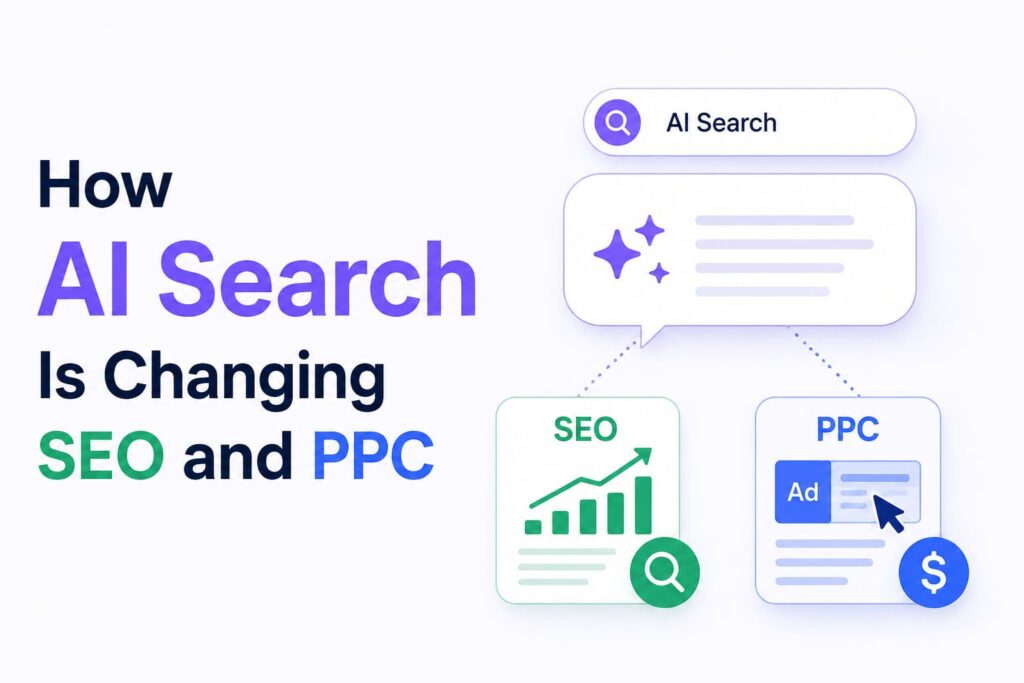
AI Overviews, ChatGPT, Perplexity, and Gemini now sit between the searcher and the results, answering the question outright and shoving both the organic links and the ads further down. That scrambles the math for both channels, not one.
For SEO, ranking first stopped being the finish line. Now you also want to be the source the AI quotes, which rewards clear, genuinely authoritative writing and punishes thin filler harder than before. For PPC, the space above the fold is shrinking and getting pricier to fight over, even as ads start appearing inside the AI answers themselves. So the lesson isn’t “back the channel that survives AI.” It’s that both channels now reward the same thing, being a trustworthy answer, and both punish trying to game your way in.
One wrinkle worth knowing on the SEO side: what gets a brand named inside those answers is mostly off-site. Correlation data puts unlinked mentions across the web well ahead of raw backlink counts as a predictor of AI visibility, which we cover in our guide to brand mentions.
When to Choose SEO, PPC, or Both
Enough theory. Here’s how I’d actually call it.
Go to PPC first when the clock matters: you need results now, you’re testing whether an offer or a market even works before pouring months into content, you’re running a promotion with an end date, or the keyword is so commercial and contested that ranking organically would take years you can’t spare. Paid is also the better test lab. You find out which keywords and which messages convert within days, then you hand those winners to your SEO team.
Bet on SEO when you’re in it for the long haul, when your margins can’t survive paying for every click until the end of time, when you’re chasing the research-stage searches that ads convert badly on anyway, and when trust is part of the sale, because people click earned results more freely than ads.
For most businesses with any history, the real answer is both, in that order. Run ads to cover the gap and collect data while your SEO is too young to carry weight. As the rankings mature and start delivering free traffic, pull the paid spend back toward the high-value, high-intent terms where it still earns its keep, and let organic own everything else. They were never really rivals. One buys you time. The other builds you equity.
Frequently Asked Questions
Over time, almost always. Paid charges you for every click with no end date, while SEO front-loads the cost and then drops to near nothing per visitor once you rank. Early on PPC looks cheaper because SEO hasn’t delivered yet. The two usually cross somewhere around nine to twelve months in.
Yes, and for most businesses it’s the strongest setup. Ads bring traffic and conversion data right away while SEO is still maturing, and what you learn from paid keywords sharpens your content plan. As organic grows, you trim paid spend down to the terms where it still pays for itself.
For most businesses the tipping point falls between month nine and month twelve, and organic keeps widening the lead after that. It shifts with competition and how much you invest, but the pattern holds nearly everywhere: paid wins early, SEO wins later.
Neither, but it reshapes both. AI answers push links and ads down the page, so the job moves from simply ranking to being the source the AI cites. Both channels now reward real authority over cheap tricks, and ads are already creeping into the AI answers too.
Making the Call for Your Business
It comes down to this. Ads get you customers this week. SEO keeps you from paying for every one of them a year from now. If you can afford both, run both and let each cover the other’s weak spot.
SEO is the harder half to get right, and the easier one to give up on too soon. If you’d rather not figure it out alone, our SEO services team can handle the organic side while your ads bring in traffic today.
Also read:

Ayush Shah
Ayush Shah is the founder of RankShifters.com, with a background in SEO, link building, content writing, and digital marketing. He works with businesses, startups, and agencies, and shares what he's learned about search and online growth.
Keep reading
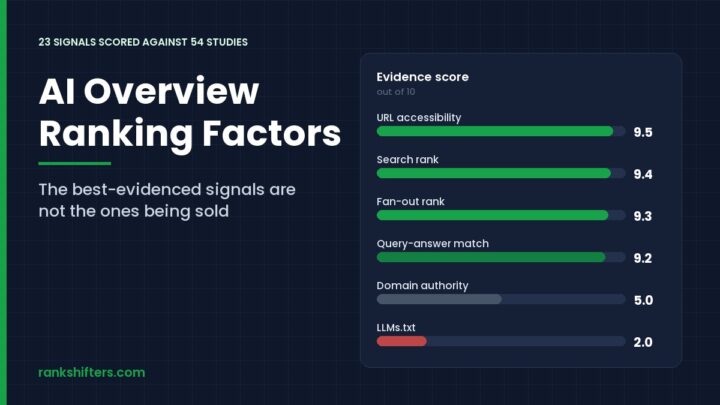
AI Overview Ranking Factors: 23 Signals, Ranked
AI Overview ranking factors are not a separate ruleset bolted on top of search. Google builds the answer box from pages already in its index, then…
Read the guide →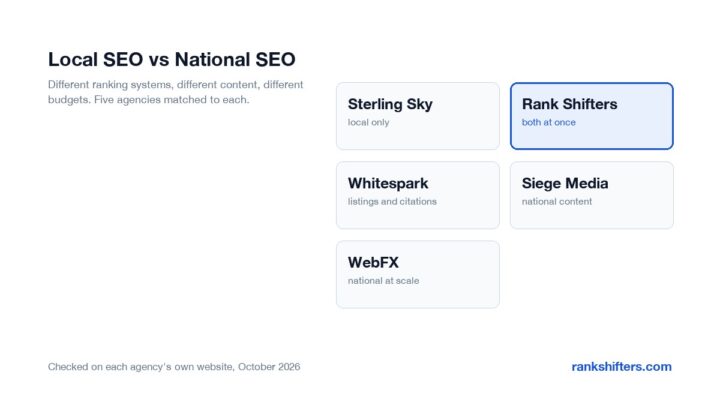
Local SEO vs National SEO: Which One Do You Need?
How local SEO and national SEO differ in ranking factors, content, link building, cost and timeline, and how to tell which one your business actually needs.
Read the guide →
DIY SEO vs Hiring an SEO Company: How to Decide
A practical comparison of doing SEO yourself against hiring an agency, covering real costs, the time it takes, where DIY hits a ceiling, and five agencies…
Read the guide →