AI Overview Ranking Factors: 23 Signals, Ranked
-
Ayush Shah
- 13 min read
What this guide covers
AI Overview ranking factors are not a separate ruleset bolted on top of search. Google builds the answer box from pages already in its index, then picks supporting links using the same quality systems that order the blue links underneath. What has changed is which of those signals carries weight, and the gap between the factors SEOs talk about and the ones with evidence behind them is wide.
This guide works through 23 factors scored against the published evidence, groups them into the four jobs they actually do, and names the ones that matter far less than their reputation suggests. Where a figure exists, it is here: the 75,000-brand correlation study, the 863,000-SERP citation analysis, and the fan-out research that explains why ranking first is no longer enough.
How Google Chooses Pages for an AI Overview
Google’s documentation sets one hard entry requirement. To appear as a supporting link, a page must be indexed and eligible to be shown in Search with a snippet. Beyond that, Google states there are no additional technical requirements to appear in AI Overviews or AI Mode.
The selection step is where AI Overviews differ from ordinary ranking. Google uses a technique it calls query fan-out: while the response is being generated, its models run additional related searches and pull supporting pages from those results. A single answer box can therefore cite pages that never ranked for the question the user typed.
That splits the problem into four jobs. Your page has to be usable at all, it has to be retrieved by one of the searches Google runs, it has to contain a passage worth lifting, and the source has to be one Google is willing to name. Every factor below belongs to one of those four jobs.
The AI Overview Ranking Factors, Ranked by Evidence Strength
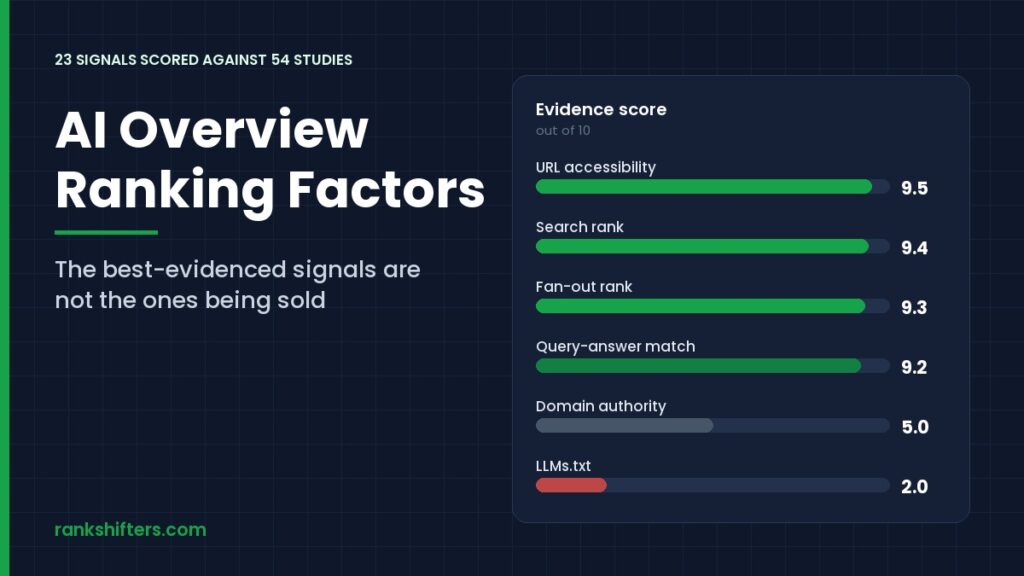
The most methodical public attempt to rank these factors comes from Cyrus Shepard, published 7 May 2026. He reviewed 54 published experiments, patents and case studies covering AI Overviews, ChatGPT, Gemini and Perplexity, then scored each factor on three criteria: how repeatable the finding was across studies, the size and quality of the data behind it, and whether official documentation or a patent supports it.
| Ranking factor | Evidence score | Job it does |
|---|---|---|
| URL accessibility | 9.5 | Eligibility |
| Search rank | 9.4 | Retrieval |
| Fan-out rank | 9.3 | Retrieval |
| Preview control | 9.2 | Eligibility |
| Query-answer match | 9.2 | Passage |
| Intent-format match | 9.0 | Passage |
| Topic cluster ranking | 8.9 | Retrieval |
| Answer near the top | 8.8 | Passage |
| AI-ready structure | 8.6 | Passage |
| Factually specific | 8.3 | Passage |
| Explicit phrasing | 8.1 | Passage |
| Cites sources | 8.0 | Passage |
| Self-contained passages | 8.0 | Passage |
| Content visibility | 7.6 | Eligibility |
| Freshness | 7.0 | Passage |
| Length | 6.7 | Passage |
| Brand and entity trust | 6.8 | Trust |
| Language | 6.3 | Passage |
| Entity consistency | 5.8 | Trust |
| Structured data | 5.6 | Eligibility |
| Known source | 5.4 | Trust |
| Domain authority | 5.0 | Trust |
| LLMs.txt | 2.0 | None found |
The scores measure how much evidence supports a factor, not how much lift it delivers. A high score means the finding held up across several studies or has documentation behind it. None of these are confirmed ranking factors in the way Google confirms indexing requirements, and the pattern across the table is that the best-evidenced factors are boring: be reachable, rank for the right queries, and answer the question plainly.
Eligibility Factors: Whether Google Can Use Your Page At All
These are gates rather than levers. Passing them earns nothing on its own, and failing any one of them removes you from consideration no matter how good the content is.
URL Accessibility
The highest-scored factor in the set. The page must return a successful response to Google’s crawlers, carry no robots.txt block, and render its content without requiring an interaction. Content loaded only after a click, a scroll event or a login cannot be cited because it is not there when the page is fetched.
Preview Control
Snippet directives decide how much of a page Google may show, and they apply to AI features as well as to classic results. A nosnippet or data-nosnippet tag, or a tight max-snippet value, removes citation eligibility along with the snippet. Many sites carry these from an old policy decision and never revisit them.
Content Visibility
Text hidden inside tabs, accordions and carousels is weighted less reliably than text in the main flow. If a passage matters enough to be quoted back to a searcher, it belongs in the visible body of the page rather than behind a toggle.
Structured Data
Schema helps Google parse a page, and Google requires it to match the visible text. It scores low here because the evidence that it drives citation is thin, and Google says directly that no special structured data is needed for AI features.
Retrieval Factors: Getting Pulled Into the Candidate Set
Retrieval is where most of the real competition sits. Google is not reading the whole web to build an answer. It runs searches, takes what those searches return, and works from that shortlist.
Search Rank
Ranking well for the query still helps more than any other active signal. The relationship has weakened, but it has not broken: organic ranking remains the single largest input to the candidate set, because the candidate set is built from search results.
Fan-out Rank
Surfer published research on 28 November 2025 covering 10,000 keywords and roughly 33,000 fan-out queries generated from them. Pages ranking for fan-out queries were 161 percent more likely to be cited than pages ranking only for the main query, and the Spearman correlation between fan-out rankings and citation was 0.77, the strongest published correlation of any factor in this article.
That single number reframes the work. Ranking first for your head term puts you in one of the searches Google runs. Ranking for the eight or ten sub-questions around it puts you in most of them.
Topic Cluster Ranking
The same logic at site level. A site that ranks across a cluster of related pages gets retrieved by more of the fan-out queries than a site with one strong page. Building the vocabulary and subtopics a subject naturally carries is how you cover the sub-questions before Google asks them.
Passage Factors: Why One Paragraph Gets Lifted and Another Is Skipped
Selection happens at passage level. Once your page is in the candidate set, the model needs a span of text it can quote, attribute and stand behind. Eight of the 23 factors describe what makes a passage usable, and they are the part of the list a writer controls directly.
Query-Answer Match and Intent-Format Match
The passage has to answer the specific question asked, in the shape that question expects. A comparison query wants a comparison, a how-many query wants a number, a process query wants ordered steps. A well-written paragraph in the wrong format loses to a plainer one in the right format.
Answer Near the Top
State the answer in the first 40 to 60 words under the heading, then explain it. A paragraph that builds towards its conclusion gives the model nothing to lift from the opening, and openings are what get read.
AI-ready Structure and Self-Contained Passages
Give each sub-question its own heading, and make each section stand on its own. Models lift a passage, not a page, so a statistic that depends on context three sections earlier will not survive extraction. Every passage should make sense to someone who has read nothing else on the page.
Factually Specific, Explicit Phrasing and Cites Sources
Claims carrying a number, a date or a named source survive extraction intact. Vague claims get paraphrased away or skipped entirely. Write “the correlation was 0.664 across 75,000 brands” rather than “brand mentions correlate strongly”, and name the source in the sentence rather than leaving it to a link.
Trust and Entity Factors: Whether Google Will Name You
Trust factors score lower on evidence than passage factors, which surprises people. The reason is that most of the evidence is correlational: it shows which brands get cited, not which actions caused it. The correlations themselves are the strongest published numbers in the field.
Ahrefs measured 75,000 brands on 26 May 2025, filtered to domains above DR 40 whose top keyword draws at least 800 searches a month, and reported Spearman correlations between each signal and the number of AI Overview mentions a brand earned.
| Brand signal | Correlation | Where it lives |
|---|---|---|
| Branded web mentions | 0.664 | Off-site |
| Branded anchors | 0.527 | Off-site |
| Branded search volume | 0.392 | Off-site |
| Domain Rating | 0.326 | Off-site |
| Referring domains | 0.295 | Off-site |
| Branded traffic | 0.274 | Off-site |
| Total backlinks | 0.218 | Off-site |
| Ad traffic | 0.216 | Paid |
| Ad cost | 0.215 | Paid |
| URL Rating | 0.18 | Page |
| Number of site pages | 0.17 | Site |
Brand and Entity Trust
Branded web mentions correlate at 0.664 against 0.295 for referring domains and 0.218 for total backlinks. A mention does not need to be a link. Being named in a roundup, a forum thread, a review or a news piece feeds the same signal, which is why a deliberate programme for earning brand mentions is a cheaper starting point than a link campaign.
Entity Consistency and Known Source
One brand name, one spelling, one description of what you do, across every profile, byline and directory. Models resolve entities by matching references to each other, and inconsistent naming splits your evidence across two entities that each look smaller.
Domain Authority
Third-party authority scores sit near the bottom of the evidence table and at 0.326 in the correlation data. Authority is not irrelevant, but it is a weaker predictor than the volume of conversation about the brand, and a far weaker one than ranking for the right queries.
The Factors That Matter Less Than Their Reputation
Four items in the table are routinely sold as AI Overview optimisation and do not hold up against the evidence.
- LLMs.txt (2.0). The lowest score in the set. Google does not use the file for AI Overviews, and no published study has found an effect.
- Freshness (7.0). It matters for time-sensitive queries and very little elsewhere. One 1,000-overview sample put the median age of a cited page at 14 months, so republishing with a new date does not win citations by itself.
- Length (6.7). Published analysis of citation position against word count found almost no relationship. Adding sections to an article that already answers the question does not improve its odds, and longer pages can make the relevant passage harder to isolate.
- FAQ markup. Google stopped showing the FAQ rich result on 7 May 2026 and removed the documentation on 15 June 2026. Adding FAQ schema to chase an answer box no longer buys the result it once did.
Page One No Longer Decides Who Gets Cited
A study published 2 March 2026 looked at 863,000 keyword SERPs and roughly 4 million cited URLs. Counting every block on the page, 37.9 percent of cited URLs also appeared in the top 10. Another 31.2 percent ranked between positions 11 and 100, and 31.0 percent ranked beyond position 100 or nowhere at all on that query.
Restricting the comparison to standard organic listings, 37.10 percent of citations came from the top 10, 26.20 percent from positions 11 to 100, and 36.70 percent from beyond the top 100. Mid-2025 figures for the same measurement put top-10 overlap near 76 percent, so the relationship between rank and citation has loosened considerably inside a year.
This is the fan-out factor showing up in the results. A page ranking 14th for its head term is not out of the running, and a page ranking first is not safe. It also explains why a handful of domains collect citations far out of proportion to their rankings, a pattern visible in the domains Google cites most often across AI Overviews.
What Google Says You Do Not Need
A large share of AI Overview advice recommends work Google has explicitly said is not required. Its documentation states there is no special schema.org structured data you need to add, and no new machine-readable file or markup for generative features. The deprecation of the FAQ rich result, which stopped appearing in Search on 7 May 2026, is the clearest example of guidance that aged badly inside a year.
- No llms.txt file is needed. Google does not use one for AI Overviews.
- No AI-only rewrite is needed. The same page serves both surfaces.
- No separate AI sitemap or markup. Standard indexing covers it.
- Do not spin a page per query variation. Google calls out thin pages built around query variants as a quality problem, and fan-out coverage comes from depth on one page plus a real cluster, not from duplicates.
Google-Extended is a separate control covering training and grounding in Google’s other AI products. It does not remove you from AI Overviews, and the snippet controls that do remove you apply across Search as a whole.
What an AI Overview Citation Is Actually Worth
Seer Interactive’s study of click-through rates on AI Overview queries covers 53 brands, 5,471,127 distinct queries and 2.43 billion organic impressions from January 2025 to February 2026.
Across informational queries in 2025, average organic click-through rate ran at 2.07 percent when the brand was cited, 0.94 percent when an AI Overview appeared without it, and 3.35 percent when no AI Overview appeared at all. Per million impressions that is roughly 20,743 clicks for cited brands against 9,445 for uncited ones.
Being cited roughly doubles clicks compared with being left out of the same box, and still earns fewer clicks than the same query would have produced with no AI Overview on the page. A citation limits a loss rather than creating a gain, which is the honest case for doing this work.
Paid behaves differently. Informational paid click-through rate averaged 15.74 percent for cited brands against 11.19 percent for uncited ones, so the citation effect carries across the whole results page rather than sitting in the organic block.
How to Track Citations in Search Console
Google includes clicks and impressions from AI Overviews and AI Mode in the Search Console performance report under the Web search type. They are not broken out separately, so Search Console tells you the combined result rather than the citation itself.
That leaves three practical checks. Watch impressions against clicks on your informational queries, because a citation without a click still registers an impression. Sample the queries that matter by hand and record which domains the box names. And use a monitoring tool that logs citations per query if the query set is too large to sample.
Expect noise. One repeat-search test found Google changed at least one citation between identical searches on 52 percent of keywords, so a single check of a single query proves very little.
Where to Put Your Effort First
The evidence scores give a clear order of work, and it is not the order most AI Overview advice recommends.
- Clear the eligibility gates. Confirm the page is indexed, crawlable and carries no snippet restriction. Nothing else matters until this is true.
- Map and rank for the fan-out queries. The 0.77 correlation is the largest published number in the field. List the sub-questions around your head term and cover them.
- Rewrite for extraction. Lead with the answer, give each sub-question a heading, keep figures inside the sentences that make the claim, and make every passage stand alone.
- Build mentions, not only links. Get named in the comparison and roundup content that already ranks for your category.
- Stop buying the overrated items. No llms.txt, no date-only refreshes, no padding for length, no FAQ markup bought for an answer box that no longer exists.
None of that conflicts with ordinary search work, which is the point Google makes in its own guidance. The signals overlap, so a page built to be cited tends to rank better too.
Frequently Asked Questions
What are the main AI Overview ranking factors?
Scored against 54 published studies and patents, the best-evidenced are URL accessibility (9.5), search rank (9.4), fan-out rank (9.3), preview control (9.2) and query-answer match (9.2). They group into four jobs: being usable, being retrieved, having a quotable passage, and being a source Google will name. Domain authority (5.0) and llms.txt (2.0) sit at the bottom.
Do I need to rank in the top 10 to be cited?
No. Across 863,000 keyword SERPs, 37.9 percent of cited URLs also ranked in the top 10 for that query. Roughly 31 percent sat between positions 11 and 100, and another 31 percent ranked beyond position 100 or not at all. Ranking for the fan-out sub-queries matters more: pages that do are 161 percent more likely to be cited.
Does FAQ schema help with AI Overviews?
Not any more. Google stopped showing the FAQ rich result in Search on 7 May 2026 and removed its documentation on 15 June 2026. Google states there is no special structured data required for AI features, though any schema you do use must match the visible text on the page.
Is a citation worth more than an ordinary ranking?
No. On informational queries in 2025, cited brands averaged 2.07 percent organic click-through rate against 0.94 percent for brands left out of the same box, but queries with no AI Overview at all averaged 3.35 percent. A citation recovers part of what the box costs rather than beating a clean results page.
Also read:

Ayush Shah
Ayush Shah is the founder of RankShifters.com, with a background in SEO, link building, content writing, and digital marketing. He works with businesses, startups, and agencies, and shares what he's learned about search and online growth.
Keep reading
Local SEO vs National SEO: Which One Do You Need?
How local SEO and national SEO differ in ranking factors, content, link building, cost and timeline, and how to tell which one your business actually needs.
Read the guide →
DIY SEO vs Hiring an SEO Company: How to Decide
A practical comparison of doing SEO yourself against hiring an agency, covering real costs, the time it takes, where DIY hits a ceiling, and five agencies…
Read the guide →
7 Best SEO Companies for Restaurants
Seven agencies that can handle restaurant search, compared on Google Business Profile work, menu and location markup, reviews and published pricing.
Read the guide →