Brand Mentions in SEO: What Google Counts and What AI Search Rewards
-
Ayush Shah
- 11 min read
What this guide covers
For about a decade, “do brand mentions help SEO?” was a question with a boring answer. Google said no, SEOs said probably, and everyone carried on building links. Nothing much rode on it.
That changed once AI answer engines started deciding which companies get named inside a response. Google’s position on unlinked mentions has not actually moved. What moved is that a second retrieval layer now sits on top of search, and that layer appears to care a great deal about how often your brand gets written about, whether or not anyone bothered to hyperlink it. This guide separates the two systems, shows what the data says about each, and covers what is worth doing about it.
Linked, Unlinked, and Implied: The Three Kinds of Brand Mention
A brand mention is any reference to your company, product, or domain on a page you do not own. The distinction that matters is not whether the mention is positive. It is whether the mention is clickable, because that single detail decides which system can act on it.
| Mention type | What it looks like | Passes link equity | Feeds AI retrieval |
|---|---|---|---|
| Linked mention | Brand name hyperlinked to your site | Yes, unless nofollowed | Yes |
| Unlinked mention | Brand named in plain text, no hyperlink | No | Yes |
| Implied link | A citation or reference that is not an express link | Patent concept only, unconfirmed | Indirectly |
| Branded search | People typing your name into a search box | No | Indirectly |
Most teams collapse all four into one number and call it “mentions.” That number tells you almost nothing, because a plain-text mention in a Reddit thread and a followed link from a trade publication do completely different jobs. Keep them separate from the start.
Google Has Said Plainly That Unlinked Mentions Pass Nothing
There is no ambiguity in Google’s public position. Asked in an SEO office hours session about articles that name a brand without linking to it, John Mueller said that a mention is not treated as a partial link. His wording, as reported by Roger Montti in Search Engine Journal in April 2022, was that “if there’s no link to your pages then it’s not really a link there” and that “there is no signal passing like there would be with any normal link.”
The counterargument SEOs reach for is a Google patent. It is a real document. US8682892B1, titled “Ranking search results,” was filed in September 2012 and granted to Google in March 2014. It draws an explicit distinction between two things. An express link is defined in the patent as “a link that is included in a source resource that a user can follow to navigate to a target resource,” while an implied link is “a reference to a target resource, e.g., a citation to the target resource, which is included in a source resource but is not an express link to the target resource.”
Two cautions before anyone builds a strategy on that. A granted patent is evidence that Google considered a mechanism, not proof it shipped one, and Google holds thousands of patents it never deployed. And in the patent’s own framing, implied links feed a quality ratio rather than handing out a ranking boost. Treat the patent as context for why the idea persists, not as a confirmed ranking factor. If you want the plain-language version of these terms, our SEO glossary covers them alongside the rest of the vocabulary.
So for classic blue-link rankings, the honest answer is the unglamorous one. An unlinked mention does not pass authority. What it can do is prompt someone to search your name later, and branded search is a signal Google has never disowned.
In AI Search, Mentions Correlate Harder Than Backlinks Do
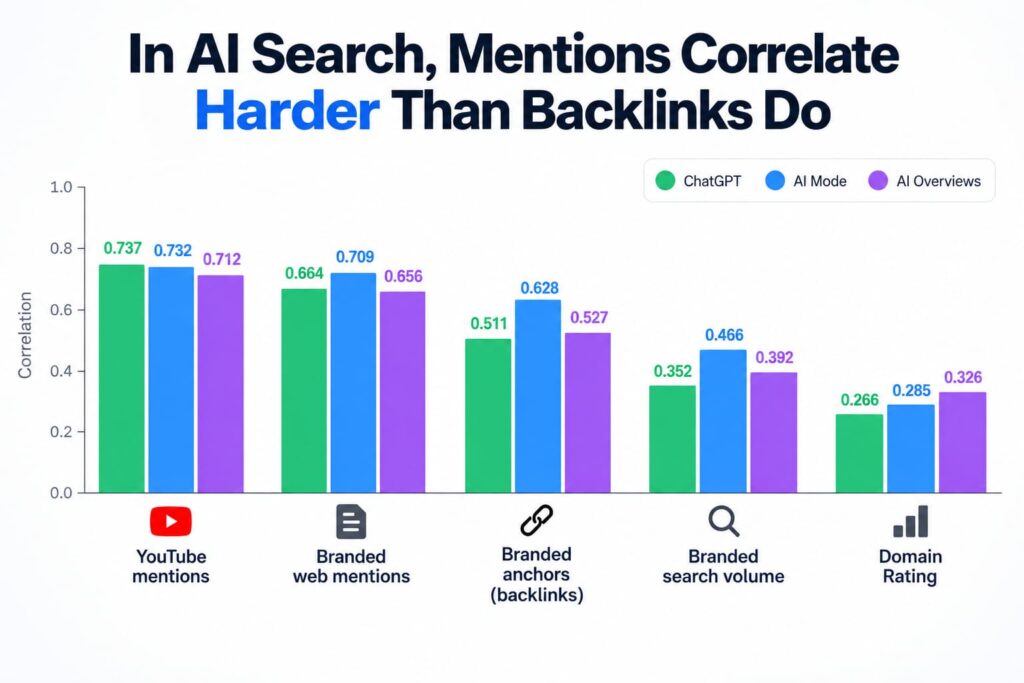
This is where the picture inverts. In December 2025, Ahrefs published a correlation study by Louise Linehan and Xibeijia Guan covering 75,000 brands, using Spearman coefficients across domains with a Domain Rating above 40. It measured which off-site signals track with a brand being visible inside ChatGPT, Google AI Mode, and AI Overviews.
| Signal | ChatGPT | AI Mode | AI Overviews |
|---|---|---|---|
| YouTube mentions | 0.737 | 0.732 | 0.712 |
| Branded web mentions | 0.664 | 0.709 | 0.656 |
| Branded anchors | 0.511 | 0.628 | 0.527 |
| Branded search volume | 0.352 | 0.466 | 0.392 |
| Domain Rating | 0.266 | 0.285 | 0.326 |
Read the ordering rather than the individual decimals. Branded web mentions correlated with AI Overviews visibility at 0.656, roughly double Domain Rating’s 0.326, and raw backlink counts trailed the whole group. The same study found almost no relationship between how much content a site publishes and how visible it is, which is worth sitting with if your current plan is to publish more.
The caveats are real and you should apply them. Correlation is not causation, and every signal in that table is downstream of the same thing: large, well-known brands get talked about more, rank better, and get named by models more often. Nobody has shown that adding mentions causes AI visibility. What the data does establish is that if you are choosing where to spend, the mention column is a better proxy for AI presence than the backlink column, and that is a genuine change from how link budgets have been allocated for twenty years. Our digital PR services exist precisely in that gap, because coverage produces both linked and unlinked mentions from the same campaign.
Being Mentioned and Being Cited Are Two Separate Scoreboards
Here is the trap that catches teams new to AI visibility reporting. Getting named inside an answer and having your page used as the source for that answer are different outcomes, measured differently, and they diverge more than you would expect.
Semrush’s 2026 AI Visibility Index, published in June 2026, analysed 126 million US AI search prompts collected between January and April 2026 across ChatGPT, Gemini, Google AI Mode, and AI Overviews, benchmarked over 22 industries. On Gemini, the overlap between brand mentions and citations fell as low as 30%. In other words, most of the time a brand was named, its own site was not the source being credited.
Platform behaviour differs sharply too. The same index found ChatGPT drew on an average of 15 sources per response while Gemini averaged 3. A three-source answer is close to winner-take-all, and only 36 global brands held top-100 visibility across all four platforms for the whole study period.
What this means practically:
- Track mentions and citations separately. A rising mention count with flat citations means the model knows you but prefers someone else’s page as evidence.
- Do not average across platforms. A strategy tuned for ChatGPT’s wide sourcing behaves differently against Gemini’s narrow one.
- Being cited requires a page worth citing. Mentions get you into the answer. Original data, clear definitions, and specific numbers get your URL attached to it.
The Surfaces Where Mentions Actually Accumulate
Mentions are not evenly valuable across the web, because AI citation is heavily concentrated. A Peec AI analysis of roughly 30 million sources, covered by Search Engine Land in March 2026, found Reddit the most-cited domain overall across the major answer engines, with clear platform-level preferences underneath that.
- Reddit and community threads. The single most-cited surface. Genuine participation only, since astroturfing gets detected and removed, and a deleted thread is worth nothing.
- YouTube. The highest correlation in the Ahrefs dataset at 0.737 for ChatGPT visibility. Being named in other people’s videos and in transcripts counts, not only your own channel.
- Wikipedia and reference sites. Heavily weighted by ChatGPT. Notability rules are strict and you cannot edit your own entry, so this is earned through third-party coverage or not at all.
- LinkedIn and B2B review platforms. Perplexity leans on LinkedIn and G2 for business queries.
- Trade and business press. Forbes and comparable outlets recur across engines, which is the classic digital PR target.
- Local directories and maps data. Google’s answers pull on Facebook and Yelp more than the others, which matters if you serve a geographic market.
The pattern to notice is that most of these surfaces are places you cannot buy a link on. That is the point. It is also why our work on the domains that appear most in Google’s AI Overviews is a better targeting list than a DR-sorted spreadsheet.
Turning Unlinked Mentions Into Links Worth Having
Link reclamation is the highest-yield outreach available to most sites, for a simple reason. The writer already knows your brand, already decided you were worth naming, and already published. You are not pitching a stranger. You are asking for a small edit to something they chose to write.
- Build the mention list. Set up Google Alerts for your brand, common misspellings, product names, and founder names. For historical coverage, run the same terms through Ahrefs Content Explorer or Semrush Brand Monitoring, which index pages rather than only alerting on new ones.
- Filter to mentions with no existing link. Both paid tools can flag results from domains that have never linked to you. This is the step that turns thousands of results into a workable list.
- Sort by whether the link would matter. Relevance and real traffic first, DR second. A niche publication your buyers read beats a high-DR site with no topical overlap.
- Ask for one specific change. Name the article, quote the sentence containing your brand, give the exact URL you want linked, and say why it helps their reader. Vague requests get ignored.
- Check the anchor text you are accumulating. Reclaimed links are usually branded anchors, which is healthy, but run the profile through our anchor text distribution checker so the mix does not drift.
- Leave the good ones alone. If a mention sits somewhere an AI engine reads and the publisher does not add links as policy, the mention still does the AI-visibility job. Do not burn the relationship over it.
Measuring Brand Mentions Without Fooling Yourself
Mention counts are easy to inflate and easy to misread. A syndicated press release can produce 200 mentions overnight across sites nobody reads, and a dashboard will happily show that as a win. Tie your reporting to things that move independently of volume.
- Branded impressions in Search Console. Filter queries containing your brand name. This is first-party, hard to game, and the closest proxy for whether awareness is actually growing.
- Mention count split by surface. Reddit, YouTube, press, and directories tracked as separate lines, because they are not interchangeable.
- Share of voice against named competitors. Absolute mention counts drift with news cycles. Your share of the category is the number that survives that.
- Citation rate, tracked apart from mention rate. Given the 30% overlap Semrush recorded on Gemini, treat these as two metrics permanently.
- Reclamation conversion. Mentions contacted versus links added, reviewed quarterly, tells you whether your outreach is working or your list is bad.
One habit worth adopting: record what caused a spike at the time it happens. Three months later, nobody remembers which podcast or launch produced the jump, and that is exactly the information you need to decide what to repeat.
Frequently Asked Questions
Do unlinked brand mentions improve Google rankings?
Not directly. John Mueller has stated that Google does not treat an unlinked mention as a partial link and that no ranking signal passes from it. The indirect route is real though: a mention prompts people to search your brand name, and branded search is a signal Google has never disputed. Treat unlinked mentions as awareness and AI-retrieval assets, not as link substitutes.
Are brand mentions more important than backlinks now?
For AI visibility, the correlation data says mentions track more closely than backlinks. Ahrefs found branded web mentions correlated with AI Overviews visibility at 0.656 versus 0.326 for Domain Rating, with raw backlink counts lower still. For classic organic rankings, links remain the mechanism that passes authority. Most sites need both, which is why campaigns that generate coverage and links together are the efficient option.
How do I find unlinked mentions of my brand?
Start with Google Alerts for your brand name, product names, founder names, and likely misspellings to catch new mentions free. For everything already published, use Ahrefs Content Explorer or Semrush Brand Monitoring, both of which can filter to domains that have never linked to you. Sort the results by topical relevance and real traffic before you contact anyone.
What is the difference between a brand mention and a citation in AI search?
A mention means the AI named your brand inside its answer. A citation means the AI linked your page as the source supporting that answer. They diverge often. Semrush measured mention-to-citation overlap on Gemini as low as 30%, meaning a brand was frequently named while a different site got credited as evidence. Track them as two separate metrics.
Where to Spend Your Next Quarter
The practical takeaway is not “mentions replaced links.” It is that one campaign now feeds two different systems, and most link budgets are only being measured against one of them. A piece of press coverage delivers a link Google can act on and a mention the answer engines can act on. A Reddit thread or a mention in someone else’s YouTube video delivers only the second, which used to make it worthless and no longer does.
If you are starting this quarter, do three things in order. Audit what already exists, because most brands have unlinked mentions sitting uncollected. Split your reporting so mentions and citations stop being one number. Then aim new campaigns at the surfaces the engines actually read rather than at whatever has the highest DR. If you would rather have that run for you, our link building services team handles the coverage, the reclamation, and the reporting as one workflow.
Also read:

Ayush Shah
Ayush Shah is the founder of RankShifters.com, with a background in SEO, link building, content writing, and digital marketing. He works with businesses, startups, and agencies, and shares what he's learned about search and online growth.
Keep reading
SEO vs PPC: Which One Deserves Your Budget in 2026?
Sooner or later every business that wants to grow online runs into the same choice. Earn your traffic slowly and keep it, or buy it today…
Read the guide →
These are the domains appear most in Google’s AI Overviews
Ahrefs analyzed millions of AI Overview responses to identify the websites Google cites most often. The results show that a small group of high‑authority, user‑generated and…
Read the guide →
Google now recommends 304 to save crawl budget
Google has updated its crawl‑budget documentation to explicitly advise websites to return a 304 Not Modified HTTP status code when a page has not changed since…
Read the guide →