7 Best Domain Authority Checker Tools
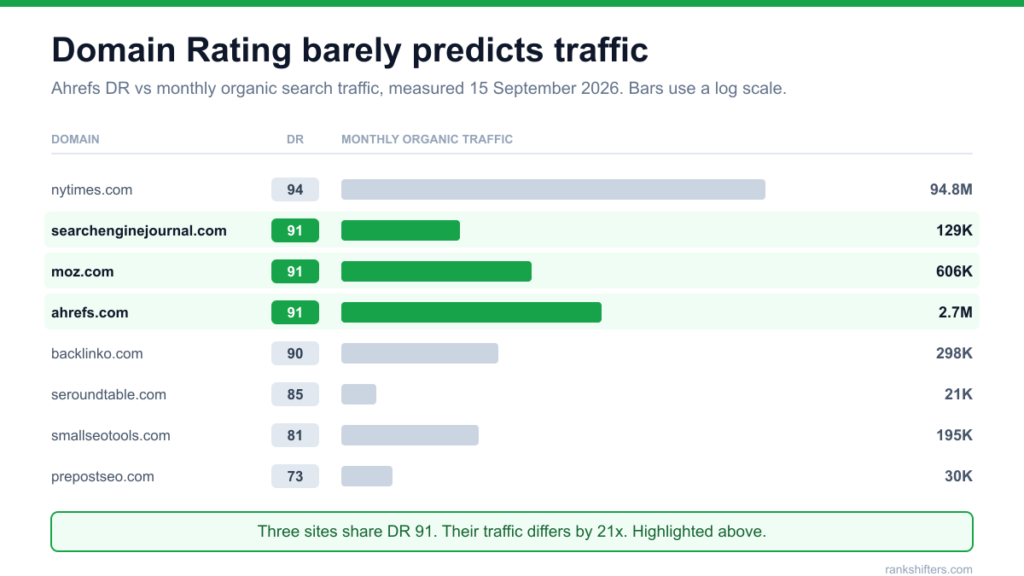
Domain Authority is Moz's estimate, not Google's metric. We measured eight domains and found three at an identical DR 91 whose real traffic differs by 21 times.
-
Ayush Shah
- Updated October 11, 2026
- 13 min read
What this guide covers
Every link buyer, outreach manager and SEO consultant eventually ends up staring at a two-digit number and deciding whether a website is worth their time. That number usually comes from a domain authority checker, and it carries far more weight in the industry than the people who built it ever intended.
A domain authority checker is a tool that estimates how strong a website’s backlink profile is, expressed as a score from 1 to 100. Domain Authority itself is a metric invented by Moz. Ahrefs calls its version Domain Rating, Semrush calls it Authority Score, and Majestic splits the idea into Trust Flow and Citation Flow. They all try to answer the same question, they all use their own crawl data, and none of them is used by Google.
This guide covers which checkers are worth using, what the score does and does not predict, and a test across eight domains that shows exactly where the number breaks down.
What a Domain Authority Checker Actually Measures
Every one of these tools does roughly the same three things. It crawls the web and records which sites link to which, it weights those links by how strong the linking sites appear to be, and it compresses the result into a single score on a 1 to 100 scale.
The differences that matter are in the inputs:
- Domain Authority (Moz) is built almost entirely on link data, modelled to predict relative ranking ability.
- Domain Rating (Ahrefs) measures the strength of a site’s backlink profile only, with no traffic or spam component at all.
- Authority Score (Semrush) blends link data with organic traffic estimates and spam signals, so it moves for reasons the others do not.
- Trust Flow and Citation Flow (Majestic) deliberately separate link quality from link quantity rather than merging them into one number.
Because each tool has its own index and its own formula, scores are not interchangeable. A site at DA 45 is not necessarily at DR 45. Pick one metric for a campaign and stay with it, because switching tools halfway through makes your before and after comparison meaningless.
Eight Domains Where the Score Did Not Match Reality
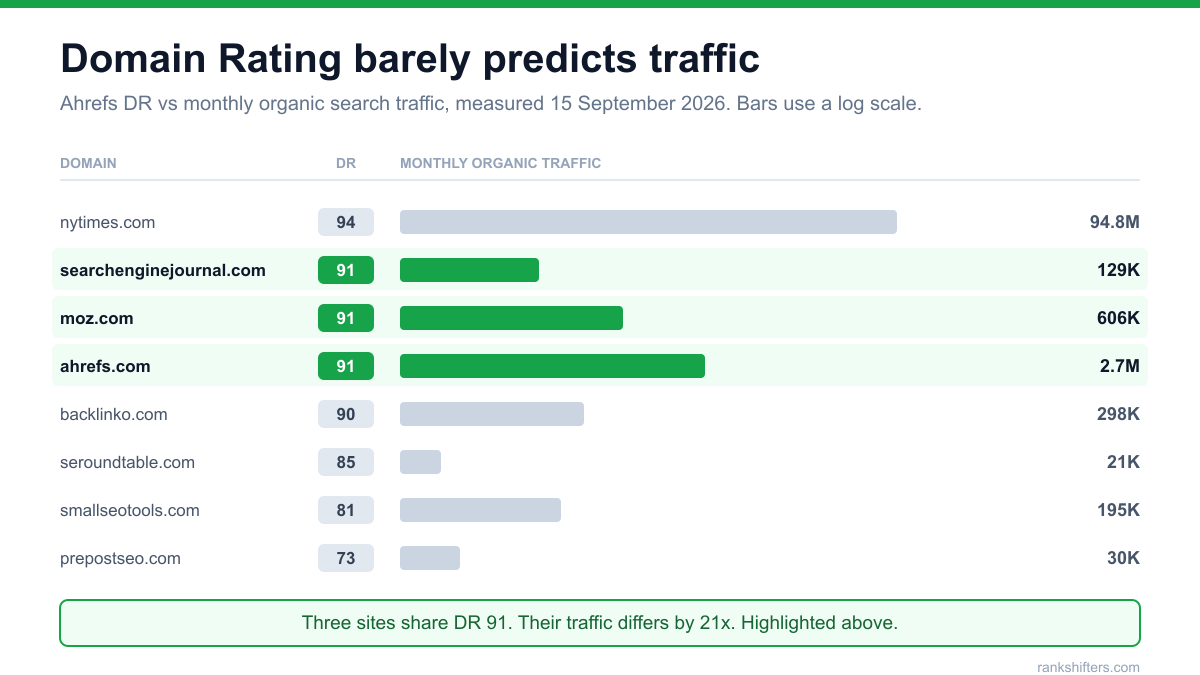
Chasing a higher score is the wrong instinct, and live data shows why. On 15 September 2026 eight well-known domains were run through the Ahrefs API, with Domain Rating, referring domains and actual monthly organic search traffic recorded side by side.
| Domain | Domain Rating | Referring domains | Monthly organic traffic |
|---|---|---|---|
| nytimes.com | 94 | 858,932 | 94,756,585 |
| searchenginejournal.com | 91 | 78,565 | 129,060 |
| moz.com | 91 | 105,022 | 605,973 |
| ahrefs.com | 91 | 113,567 | 2,729,706 |
| backlinko.com | 90 | 58,622 | 297,994 |
| seroundtable.com | 85 | 21,717 | 21,240 |
| smallseotools.com | 81 | 15,258 | 194,734 |
| prepostseo.com | 73 | 8,598 | 30,074 |
Three findings are worth sitting with.
Identical scores, wildly different outcomes. Search Engine Journal, Moz and Ahrefs all sit at DR 91. Their monthly organic traffic runs from 129,060 to 2,729,706. That is a 21-fold spread between sites a checker would tell you are equally strong. If you were buying links and screening purely on DR, all three would look like the same purchase.
A lower score can mean more traffic. smallseotools.com sits ten points below Search Engine Journal at DR 81, yet pulls roughly 195,000 monthly organic visits against SEJ’s 129,000. The weaker-looking domain is the busier one.
The scale is logarithmic, not linear. The New York Times scores DR 94 with 858,932 referring domains. Ahrefs scores DR 91 with 113,567. Three points of difference conceal a 7.6x gap in referring domains. This is why climbing from DA 20 to DA 30 takes months and climbing from 70 to 80 can take years, and why treating the scale as a straight line leads to badly wrong expectations.
One more comparison makes the point about link efficiency. Search Engine Roundtable holds 21,717 referring domains and draws about 21,240 monthly organic visits, roughly one visit per referring domain. The New York Times draws around 110 visits per referring domain. Two respected publishers, a hundredfold difference in what each link is worth in traffic terms.
Google Does Not Use Domain Authority
This needs saying plainly because a lot of content blurs it. Domain Authority is a third-party estimate produced by a private company. It is not a Google metric, it is not an input to Google’s ranking systems, and improving it does not directly cause anything to happen in search results.
Google’s John Mueller has addressed this repeatedly, saying that you do not need a DA for Google Search and that Google does not use it. He has also said Google has nothing resembling a single website authority score internally. Ahrefs says the same thing about its own metric in its official documentation, which is a useful signal given the commercial incentive to claim otherwise.
There is a real nuance underneath. Google does evaluate sites at a site-wide level in some respects, and link-based signals genuinely do influence rankings. What does not exist is a number inside Google that corresponds to the one your checker shows you. The correlation people observe is real but indirect: sites with strong link profiles tend to rank better, and DA is an attempt to model that tendency from the outside.
The practical consequence is that DA is a comparative screening tool, not a target. It is useful for ranking 200 outreach prospects against each other. It is close to useless as a KPI reported to a client in isolation.
7 Domain Authority Checkers Worth Using
Pricing below was verified in September 2026. Vendors change plans often, so treat the figures as a snapshot rather than a permanent fact.
1. Moz Link Explorer, the original Domain Authority
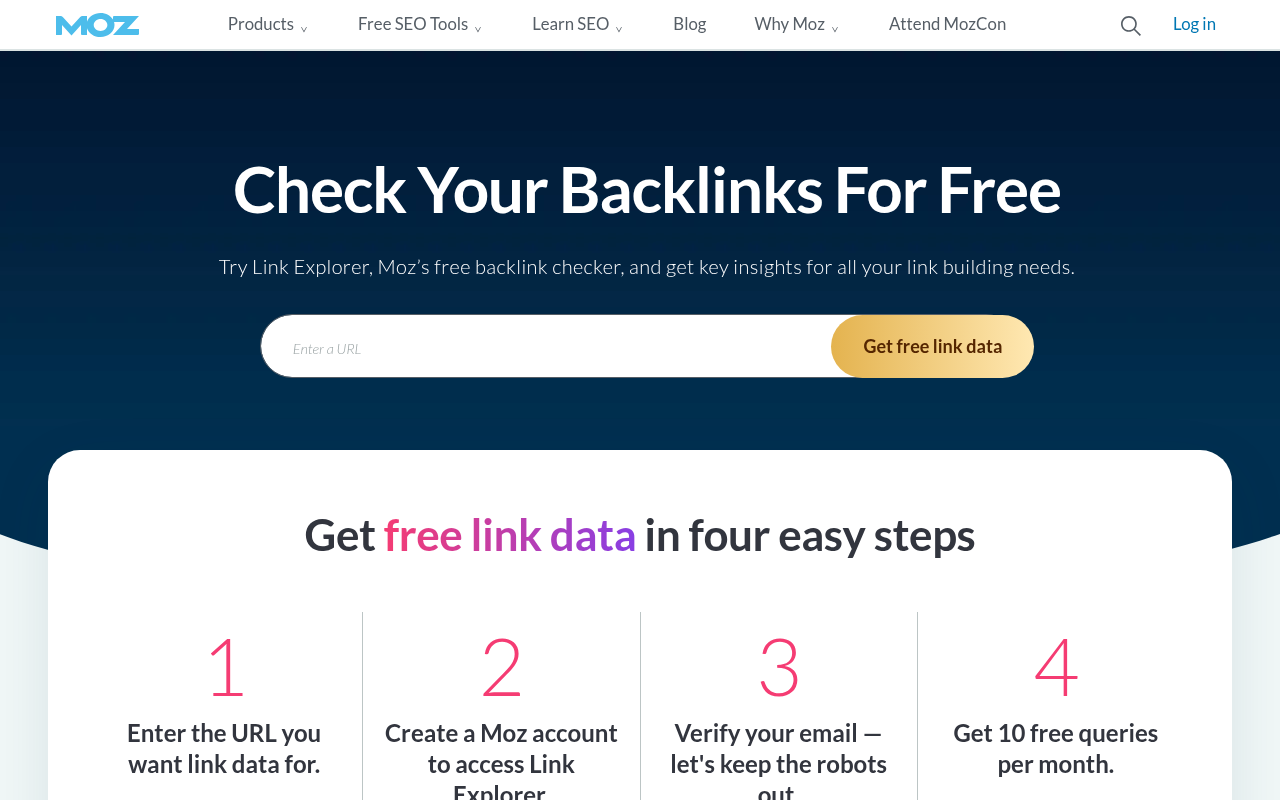
Moz invented the DA metric, so if a client or publisher quotes you a DA figure, this is the source they mean. Link Explorer returns Domain Authority, Page Authority, Spam Score and linking root domains together, which makes it the most direct way to sanity-check a number someone else has given you.
- A free Moz account includes 10 Link Explorer queries per month, which the tool states on the page itself
- Moz Pro runs from a $49 per month Starter plan up to Standard at $99, Medium at $179 and Large at $299, with roughly 20% off for annual billing
- Best for anyone who needs the canonical DA number rather than an approximation of it
2. Ahrefs Website Authority Checker, the deepest link index
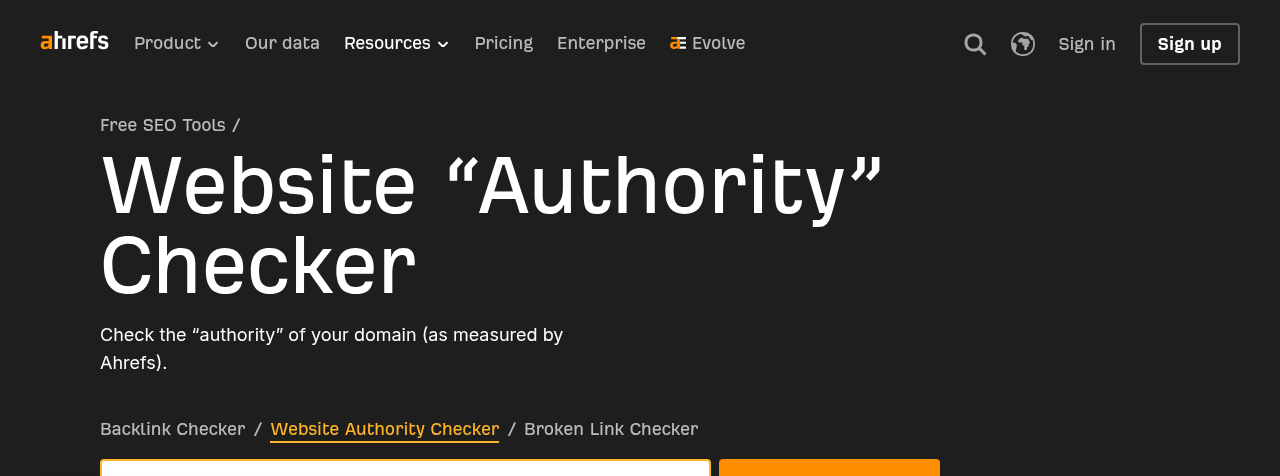
Ahrefs reports Domain Rating, which measures backlink profile strength alone. Because DR excludes traffic and spam signals it is the cleanest read on pure link equity, and the underlying index is among the largest in the industry. The free authority checker returns DR without a subscription.
- Free tools return DR, backlink count and referring domains for any domain
- Ahrefs Free gives deeper data for a site you can verify ownership of
- Paid plans run $29 for Starter, then $129 Lite, $249 Standard and $449 Advanced per month
- Best for serious link prospecting where the depth of the backlink index decides the answer
3. Semrush Authority Score, the one that factors in traffic
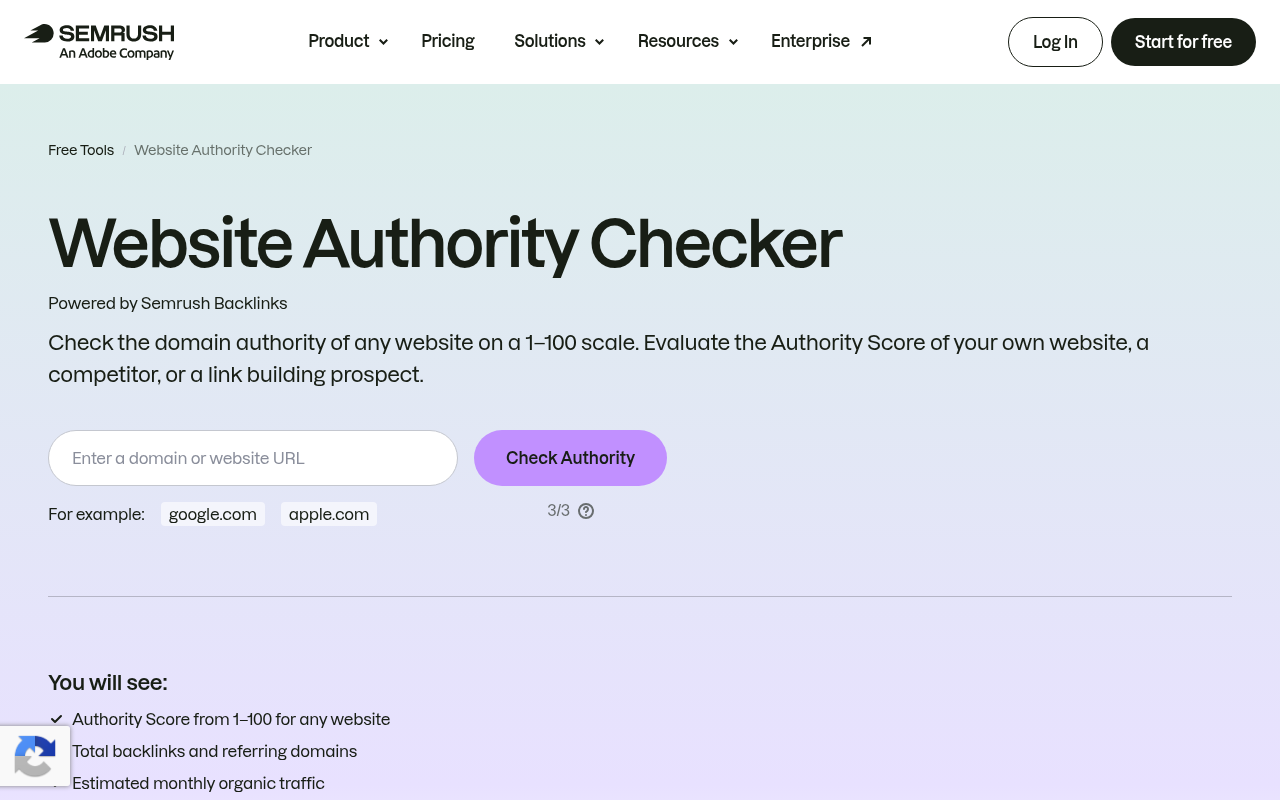
Semrush, which Adobe acquired for around $1.9 billion in a deal that completed in April 2026, folds organic traffic and spam detection into its Authority Score alongside link data. That makes it the most useful single number for spotting the failure mode our test exposed, because a domain with strong links and no traffic scores lower here than it would on a pure link metric.
- Authority Score combines backlink strength, organic traffic and spam signals in one figure
- The free Website Authority Checker allows three lookups without an account, and the page shows your remaining checks
- Paid plans start at $139 per month for SEO, then $199 Starter, $299 Pro+ and $549 Advanced
- Best for teams that want authority and traffic quality in a single screening number
4. Majestic, for separating link quality from link volume
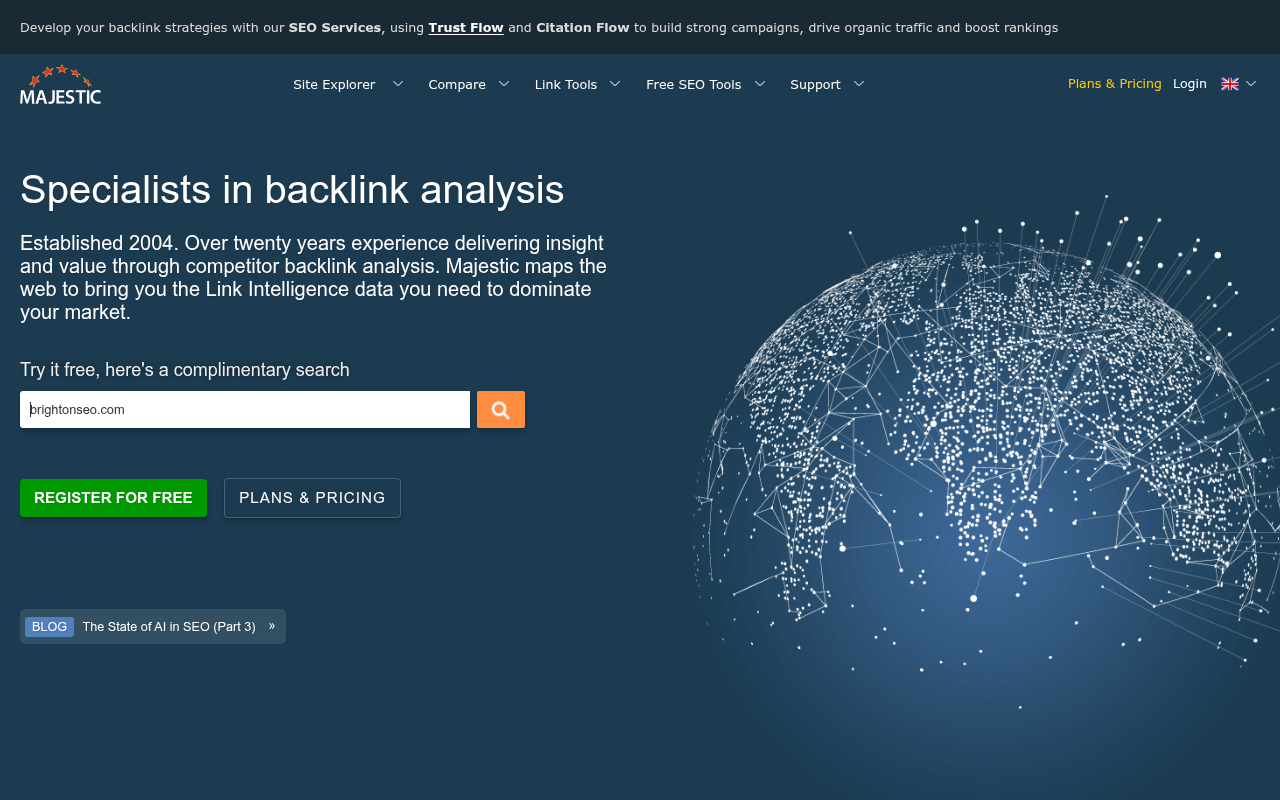
Majestic refuses to collapse everything into one score, and that is its advantage. Trust Flow rates the quality of the sites linking to you, Citation Flow rates the raw volume. A domain with high Citation Flow and low Trust Flow has collected a lot of links that nobody trustworthy vouches for, which is a pattern worth catching before you buy a placement.
- Topical Trust Flow shows which subject areas a domain has earned authority in, not just how much
- A free backlink checker and the Majestic Million list are available without a subscription
- Plans run $49.99 per month for Lite, $99.99 for Pro and $399.99 for API access
- Best for experienced link builders qualifying outreach targets at volume
5. SE Ranking Domain Trust, built for client reporting
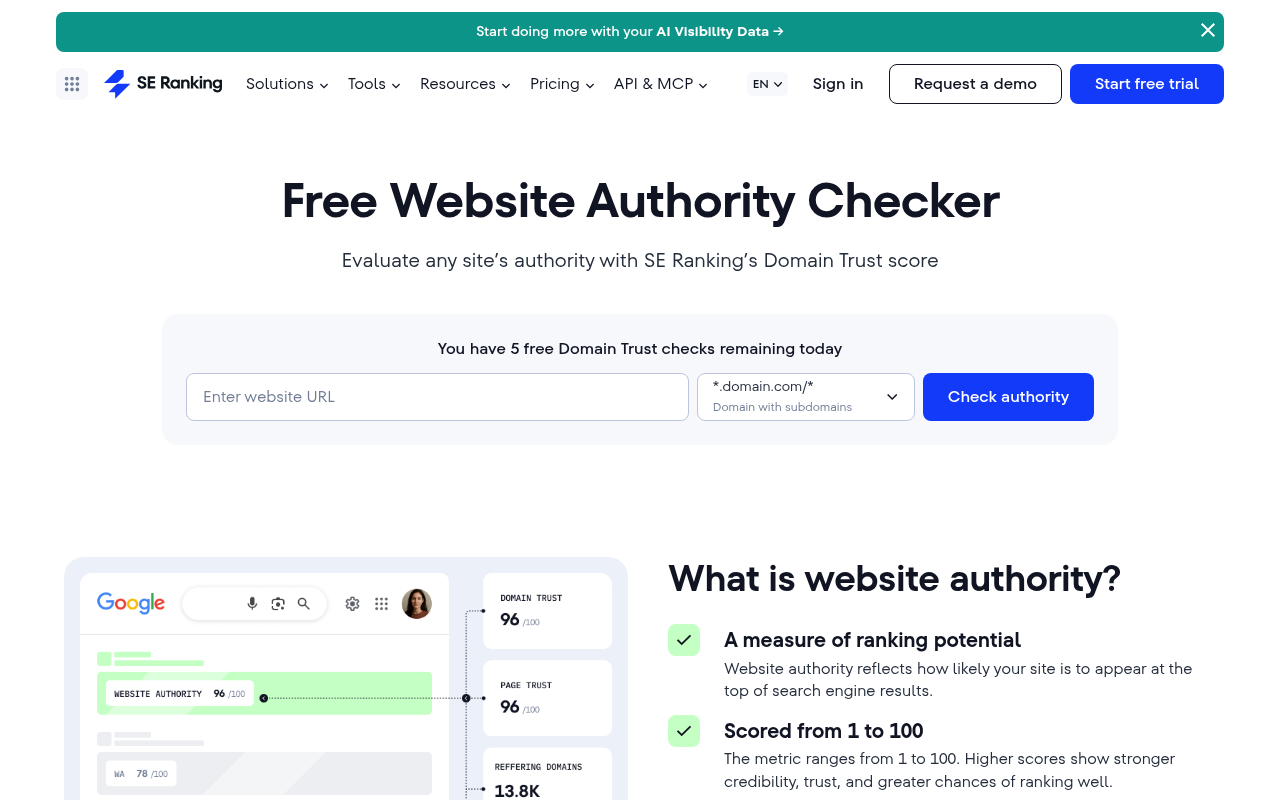
SE Ranking reports Domain Trust and Page Trust as separate figures and gives you five free checks per day without an account, which is the most generous free allowance of the paid platforms here. It packages those metrics inside a system designed around agency reporting. If you need to show authority movement to a client every month in a branded report, the reporting layer matters as much as the metric.
6. Ubersuggest, the gentlest starting point
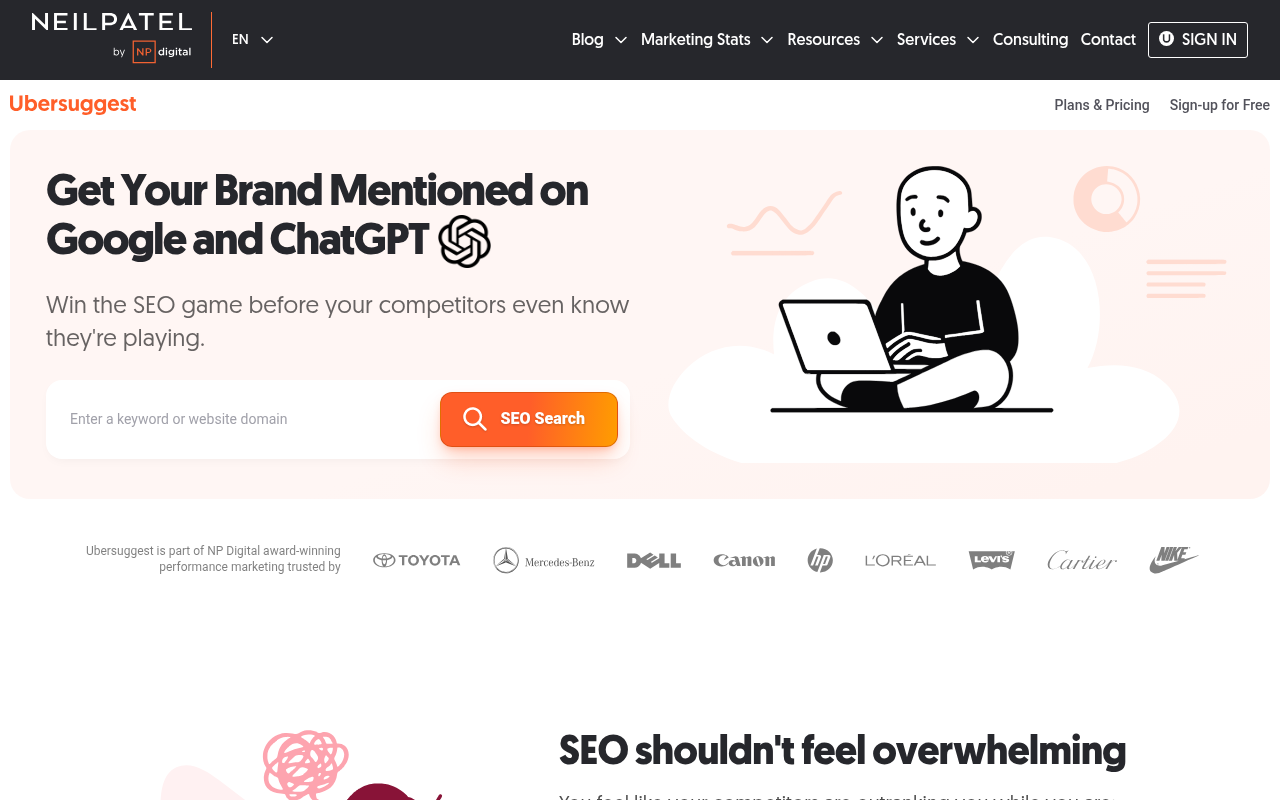
Ubersuggest puts a domain score next to traffic estimates, backlink counts and top keywords, with a small number of free lookups per day. For someone learning what these numbers mean, seeing the score next to the traffic it is supposed to predict is genuinely instructive, especially given what our test found.
7. Free bulk checkers, for screening long lists
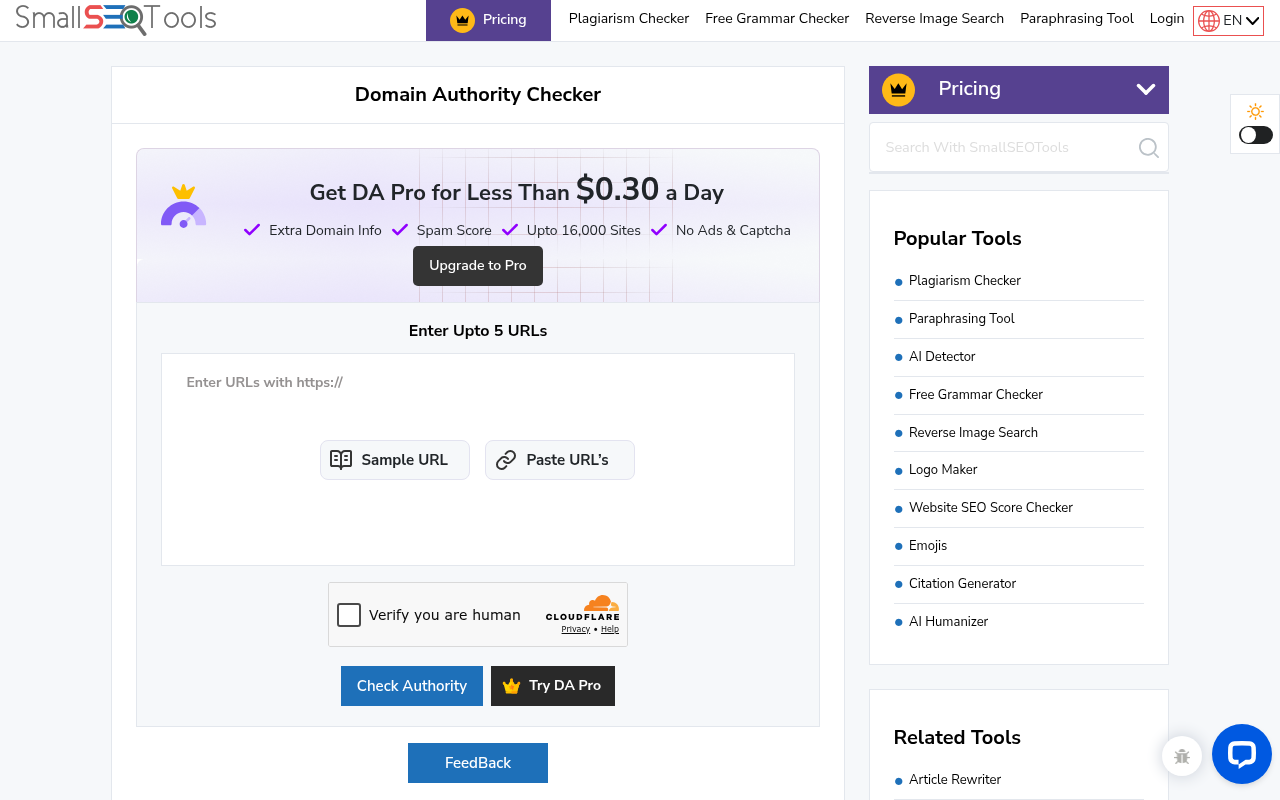
Tools such as SmallSEOTools and Prepostseo let you paste a batch of domains and get DA and PA back without an account. Check the current limits rather than trusting a roundup, ours included. SmallSEOTools caps a batch at five URLs and asks you to clear a human-verification step first, despite being widely described elsewhere as accepting ten. These services pull Moz-derived data through an API rather than maintaining their own index, so treat them as a fast first filter, not a source of truth. When a domain matters, re-check it in Moz or Ahrefs directly.
| Tool | Metric | Free option | Best for |
|---|---|---|---|
| Moz Link Explorer | Domain Authority | Limited, free account | The canonical DA figure |
| Ahrefs | Domain Rating | Free checker, no account | Pure link strength |
| Semrush | Authority Score | Limited free tools | Authority plus traffic quality |
| Majestic | Trust Flow / Citation Flow | Free backlink checker | Quality versus volume |
| SE Ranking | Domain Trust | Trial | Agency client reporting |
| Ubersuggest | Domain score | A few checks per day | Beginners |
| Bulk free checkers | DA and PA | Unlimited | First-pass list screening |
How to Check Domain Authority in Under a Minute
- Open one checker and commit to it for the whole project, so your numbers stay comparable.
- Paste the root domain rather than a deep URL, unless you specifically want Page Authority for one page.
- Record the score together with referring domains and organic traffic. The score alone is the least informative of the three.
- Check the trend rather than the snapshot. A domain falling from 60 to 52 is a different proposition from one climbing from 44 to 52.
- Benchmark against the sites actually ranking for your target keywords, not against an arbitrary threshold.
For link prospecting specifically, add two checks the score will never give you. Look at whether the site’s traffic is trending up or down, and look at its outbound link patterns. A domain with a healthy score that publishes twenty sponsored posts a week is not the opportunity the number suggests. Our anchor text distribution checker will also show whether a prospect’s own link profile looks natural or engineered.
What Counts as a Good Score
There is no universal threshold, and anyone quoting one is skipping the part that matters. A score is only meaningful next to the competition for the keywords you want.
| Score range | What it usually indicates | Sensible next move |
|---|---|---|
| 1 to 20 | New or barely linked domain | Publish genuinely useful pages, earn first editorial links |
| 20 to 40 | Growing, some real authority | Build links consistently, fix technical debt |
| 40 to 60 | Established and competitive in most niches | Target harder keywords, deepen topical coverage |
| 60 and above | Strong profile, hard to displace | Protect the profile, monitor lost links |
Context beats the number every time. A DA 25 site in a niche where the top results are all DA 30 is well positioned. A DA 55 site competing against DA 85 publishers is not, however healthy 55 sounds. Domain age plays into this too, since authority accumulates slowly, and you can check any prospect’s age with our domain age checker before reading too much into a low score on a site launched last quarter.
Raising the Score Without Gaming It
Because DA is modelled on links, the only durable way to move it is to earn links that a model would recognise as legitimate. Everything else is either slow-acting or actively risky.
- Earn links from distinct domains. Fifty links from one site move the needle far less than five links from five sites, because unique referring domains are what these models weight.
- Prioritise relevance over raw score. A DR 40 link from a site in your industry is generally worth more than a DR 75 link from an unrelated general blog.
- Build assets people cite. Original data, free tools and genuine research attract links without outreach. The table earlier in this article is an example of the format.
- Tidy your internal linking. Internal links do not raise DA directly, but they redistribute authority to the pages you actually want ranking.
- Monitor lost links. Losing established links pulls a score down faster than most people expect, and lost links are easier to reclaim than new ones are to earn.
What does not work: buying cheap links from low-quality sources, mass directory submissions, and reciprocal link schemes. These either get discounted by the model or trip Google’s link spam policies, which is a much more expensive problem than a low score. If you would rather have the earning side handled properly, our link building services team runs the prospecting, outreach and reporting as one workflow. Unfamiliar terminology along the way is covered in our SEO glossary.
Frequently Asked Questions
How do I check Domain Authority?
Open a domain authority checker such as Moz Link Explorer or the Ahrefs website authority checker, paste the root domain, and read the score. Both return a result in seconds without a paid plan, though free checks are limited per month. Record referring domains and organic traffic at the same time, because the score on its own tells you less than the three figures together.
Is Domain Authority real?
It is a real metric, but it is Moz’s metric rather than Google’s. The score genuinely reflects Moz’s measurement of a backlink profile, and it correlates loosely with ranking ability. It is not something Google calculates, stores or uses. Treat it as one vendor’s informed estimate, which is exactly how Moz presents it.
What does Domain Authority do?
Its practical job is comparison. It lets you rank a list of sites against each other quickly, which is why link builders and outreach teams use it to screen prospects. It does not do anything inside Google, and raising it does not cause rankings to improve by itself. The link building that raises the score is what affects rankings.
How can I check the reputation of my domain?
Authority scores are only part of reputation. Check Moz Spam Score or Semrush’s toxicity signals for harmful backlinks, review Google Search Console for manual actions, and look at Majestic Trust Flow against Citation Flow, since a large gap suggests volume without credibility. For deliverability and security reputation, which is a separate question entirely, check Google Postmaster Tools and your domain’s blocklist status.
Use the Score as a Filter, Not a Finish Line
A domain authority checker is genuinely useful for the job it was built for: sorting a long list of sites quickly so you can spend your attention on the plausible ones. It is a filter. The eight domains we measured show what happens when it gets promoted into a target instead, with three sites at an identical DR 91 separated by a 21-fold gap in real traffic.
Screen with the score, then decide with the evidence underneath it. Traffic trend, topical relevance, outbound link behaviour and whether real people read the site will tell you more about a link prospect than any two-digit number, and none of them take much longer to check.
Also read:

Ayush Shah
Ayush Shah is the founder of RankShifters.com, with a background in SEO, link building, content writing, and digital marketing. He works with businesses, startups, and agencies, and shares what he's learned about search and online growth.
Keep reading
AI Overview Ranking Factors: 23 Signals, Ranked
AI Overview ranking factors are not a separate ruleset bolted on top of search. Google builds the answer box from pages already in its index, then…
Read the guide →
Local SEO vs National SEO: Which One Do You Need?
How local SEO and national SEO differ in ranking factors, content, link building, cost and timeline, and how to tell which one your business actually needs.
Read the guide →
DIY SEO vs Hiring an SEO Company: How to Decide
A practical comparison of doing SEO yourself against hiring an agency, covering real costs, the time it takes, where DIY hits a ceiling, and five agencies…
Read the guide →