Digital PR for SEO: How It Earns Links and Rankings
Digital PR for SEO explained: how press coverage earns links and mentions, the campaign types that work, pitching tips and how to measure it.
-
Ayush Shah
- 6 min read
Digital PR for SEO uses press coverage to earn links and brand mentions from news sites, magazines and industry publications. A story, data set or expert comment gets picked up by journalists, and the articles they publish link back to your site.
Those links come from some of the most trusted domains on the web, which is why digital PR has become one of the main ways competitive sites build authority. This guide covers how it helps rankings, which campaigns work and how to measure them.
What Is Digital PR in SEO?
Digital PR is public relations aimed at online coverage. Traditional PR measures success in press mentions and audience reach. Digital PR for SEO adds a second goal: every piece of coverage should include a link to your site, ideally to a page that matters for your rankings.
The work looks like newsroom work. Teams find a story in their data or their expertise, package it with a headline journalists can use, and pitch it to reporters who cover that subject.
How Digital PR Helps SEO and Rankings
Google’s John Mueller described digital PR in January 2021 as “just as critical as tech SEO, probably more so in many cases.” The value shows up in four ways:
- Authoritative links: coverage on news and industry sites brings links from domains with large, trusted link profiles of their own.
- Brand mentions: even unlinked coverage puts your name on trusted sites, which feeds how search engines and AI tools understand your brand.
- Referral traffic and brand searches: readers click through and search for you by name afterwards.
- Value passed to key pages: a campaign page that earns links passes some of that value to product and service pages through your internal links.
Digital PR vs Traditional Link Building
| Digital PR | Outreach link building | |
|---|---|---|
| Who you contact | Journalists and editors | Site owners and bloggers |
| What you offer | A story, data or expert comment | An article, resource or fix |
| Typical links | News and magazine sites | Blogs and niche sites |
| Links per success | Can be dozens from one story | Usually one per placement |
| Predictability | Lower: coverage is not guaranteed | Higher: placements agreed in advance |
The two work best together. Outreach gives steady, targeted links to specific pages; digital PR brings occasional bursts of high-authority links. Our explainer on what link building is covers the other methods.
Digital PR Tactics That Earn Coverage
Data-Led Campaigns
Original surveys, analyses of public data or anonymised data from your own product give journalists a fresh statistic. A “best cities for X” ranking, an annual index or a survey with one surprising number can be picked up across a whole industry in a few days.
Reactive PR and Newsjacking
When a story breaks in your industry, journalists need comment and context fast. Sending a sharp, quotable expert view within hours of the news is one of the quickest ways to earn coverage.
Expert Commentary Through Journalist Requests
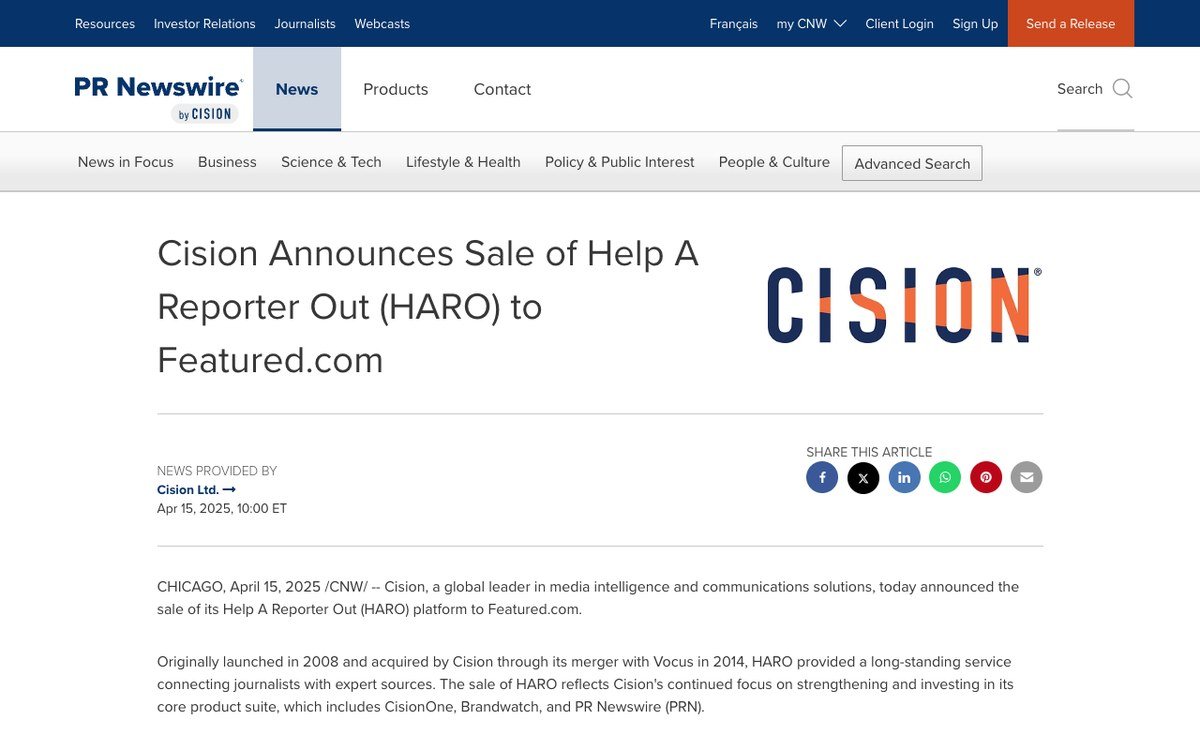
Reporters post requests for sources on dedicated platforms. HARO, the best-known one, changed hands in 2025: Cision announced the sale of HARO to Featured.com in April 2025, after discontinuing its Connectively relaunch. It now runs under Featured with free daily requests. Featured and Qwoted are the other main options.
Creative Campaigns and Tools
Interactive maps, calculators, visual studies and quizzes give journalists something to embed or describe, and give readers a reason to share.
Reclaiming Unlinked Mentions
Coverage often names your brand without a link, or links to the wrong page. A short note to the writer asking for the link to be added or corrected turns existing coverage into SEO value.
How to Pitch Journalists So They Reply
Most pitches miss. In Muck Rack’s State of Journalism 2026 survey, 47% of journalists said pitches are seldom or never relevant to them, and 51% said only 1 to 10% of their stories started with a pitch. Yet 73% said PR professionals are at least moderately important to their work. The pitches that land share a few traits:
- Sent only to reporters who cover that exact beat
- A subject line that states the story, not the brand
- The key finding or quote in the first two lines
- Data, methodology and images ready to send immediately
- No attachments or follow-up chains for reporters who did not reply
Do Nofollow Links From News Sites Help SEO?
Many large publishers mark outbound links nofollow. Since Google’s September 2019 change, nofollow is treated as a hint rather than a command, and since 1 March 2020 that applies to crawling and indexing too. Google may still use some of those links.
Nofollowed coverage still brings referral visitors, brand searches and mentions, and other writers who pick up the story often link without nofollow. Judge a campaign on all of it, not on the followed links alone.
Digital PR and AI Search Visibility
Coverage matters for AI answers as well as rankings. An Ahrefs study of 75,000 brands, published in May 2025, found branded web mentions had a 0.664 correlation with appearing in Google’s AI Overviews, ahead of branded anchors at 0.527, branded search volume at 0.392 and backlinks at 0.218. Correlation is not proof, but it points the same way as digital PR: get your brand discussed on trusted sites. More on that in brand mentions in SEO and AI search optimization.
How to Measure Digital PR for SEO
- Referring domains: new linking sites, and how relevant and trusted they are
- Coverage: articles published, linked and unlinked
- Rankings of target pages: movement on the pages the campaign was meant to lift
- Referral traffic: visits from coverage in your analytics
- Branded search: impressions for your brand name in Search Console
Digital PR Mistakes That Create SEO Risk
Google’s link spam policy names “links with optimized anchor text in articles, guest posts, or press releases distributed on other sites.” Keyword-stuffed press releases sent out for links are the clearest example. Sending someone a product in exchange for a post with a link is also listed. If a publication charges for a placement, the link should carry rel=”sponsored”, per Google’s guide to qualifying outbound links.
Our digital PR services build data-led campaigns and pitch them to journalists on your beat, with every piece of coverage reported back. For the wider set of methods, see how to get high authority backlinks.
Frequently Asked Questions
Is digital PR the same as link building?
Digital PR is one form of link building. It earns links through press coverage, while link building also covers guest posts, broken link outreach and other methods that do not involve journalists.
How long does digital PR take to work?
A campaign usually takes several weeks from idea to coverage, and links can keep arriving for months as other sites cite the original story. Rankings move once Google has crawled the new links.
Is HARO still available?
Yes. Cision discontinued HARO and its Connectively relaunch, then sold HARO to Featured.com in April 2025. HARO now runs under Featured with free daily journalist requests.
Can small businesses use digital PR?
Yes. Local data stories, expert comment for local and trade press, and journalist request platforms work on small budgets. A single strong story in a trade publication can be worth more than broad national coverage.
Related Articles

Ayush Shah
Ayush Shah is the founder of RankShifters.com, with a background in SEO, link building, content writing, and digital marketing. He works with businesses, startups, and agencies, and shares what he's learned about search and online growth.
Keep reading
Law Firm SEO: How to Rank a Law Firm Website
How to rank a law firm website, step by step: Google Business Profile, site structure, practice area content, reviews, schema and links that stay ethical.
Read the guide →
White Hat vs Black Hat Link Building: What Google Allows
White hat vs black hat link building, mapped to Google's own link spam policy, plus the grey areas and how to recover from unnatural links.
Read the guide →
SaaS Link Building: 8 Strategies That Earn Links
The link building strategies that work for SaaS companies, with real examples, the pages links should point to, and the tactics to avoid.
Read the guide →