7 Best SEO Companies for SaaS Businesses
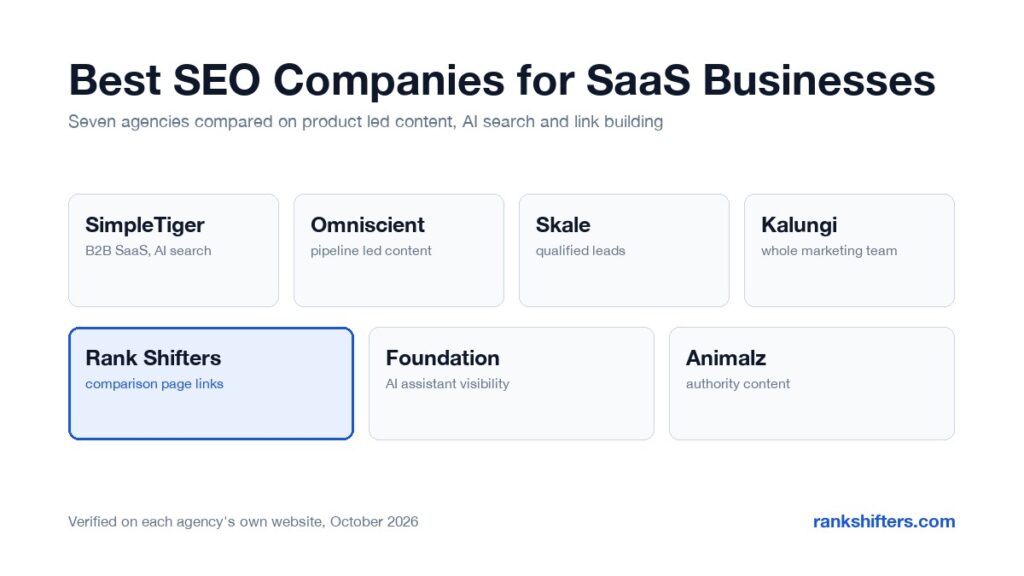
Seven agencies that specialise in software companies, compared on product led content, bottom of funnel pages, AI search visibility and what each publishes about pricing.
-
Ayush Shah
- Updated October 11, 2026
- 10 min read
What this guide covers
SaaS SEO is judged on pipeline, not traffic, and that single difference rules out most general agencies. The pages that matter are comparison pages, alternatives pages, integration pages and use case pages, all of which need someone who understands the product well enough to write about it without embarrassing you in front of buyers.
The second complication is that software buyers increasingly start in an AI assistant rather than a search box. Being the answer a model gives has become part of the job. The seven agencies below all name B2B software as their specialism.
What a SaaS SEO programme has to include
If a proposal is mostly blog posts, it is a content programme wearing an SEO label.
- Bottom of funnel pages: comparisons, alternatives, integrations and pricing related queries.
- Product led content where the product is the answer, not an afterthought in the final paragraph.
- Visibility inside AI assistants, which is now a real acquisition surface. Google’s documentation on AI features in search explains how Google frames it.
- Technical work on documentation, changelogs and marketing site separation.
- Link building to commercial pages, which is harder than earning links to a research report.
- Reporting that ties rankings to signups, trials and pipeline rather than to sessions.
Seven SaaS SEO agencies compared
Every row reads custom because none of these agencies publishes fixed retainer pricing.
| Agency | Best for | Core services | Pricing |
|---|---|---|---|
| SimpleTiger | B2B SaaS focused entirely on pipeline | SaaS SEO, AI search, content, paid, technical SEO | Custom pricing, published on request |
| Omniscient Digital | B2B software scaling content into a growth channel | SEO, generative engine optimisation, content strategy and production | Custom pricing |
| Skale | SaaS companies measuring SEO in qualified leads | SaaS SEO strategy, content, technical SEO, outreach | Custom pricing |
| Kalungi | B2B SaaS with no marketing team at all | Outsourced SaaS marketing department, demand generation, SEO, go to market | Custom pricing |
| Rank Shifters | SaaS companies whose comparison pages will not rank | SaaS link building, technical SEO, content, digital PR | Custom, quoted within one working day |
| Foundation | B2B tech chasing visibility inside AI assistants | AI visibility, generative engine optimisation, content, distribution, SEO | Custom pricing |
| Animalz | SaaS brands that need authority content at volume | Content strategy and production, SEO, answer engine optimisation, research reports | Custom pricing |
Seven SEO companies built for software businesses
1. SimpleTiger
Best for: B2B SaaS focused entirely on pipeline
Core services: SaaS SEO, AI search, content, paid, technical SEO
Pricing: Custom pricing, published on request
Website: simpletiger.com
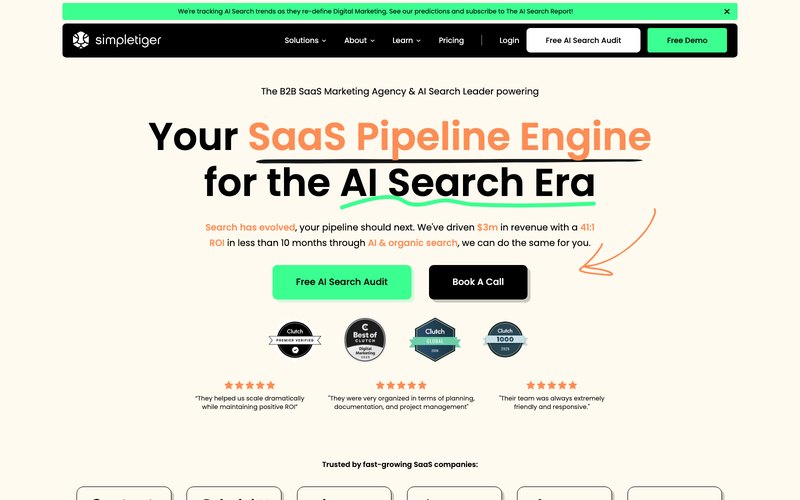
SimpleTiger works exclusively with B2B software companies and has restructured its offer around AI search alongside classic organic. The agency publishes an AI search report and offers a free AI search audit, which is a practical way to see how a team thinks before you commit.
For a software business whose buyers now start in ChatGPT or Perplexity as often as Google, an agency that treats both surfaces as one problem is a better fit than one adding AI as a late extra.
Pros
- SaaS only, so no translation from other verticals
- Serious investment in AI search, not a bolt-on service
- Free audit available before any commitment
Cons
- B2B only, so consumer software is out of scope
- Retainer pricing is not published openly
2. Omniscient Digital
Best for: B2B software scaling content into a growth channel
Core services: SEO, generative engine optimisation, content strategy and production
Pricing: Custom pricing
Website: beomniscient.com
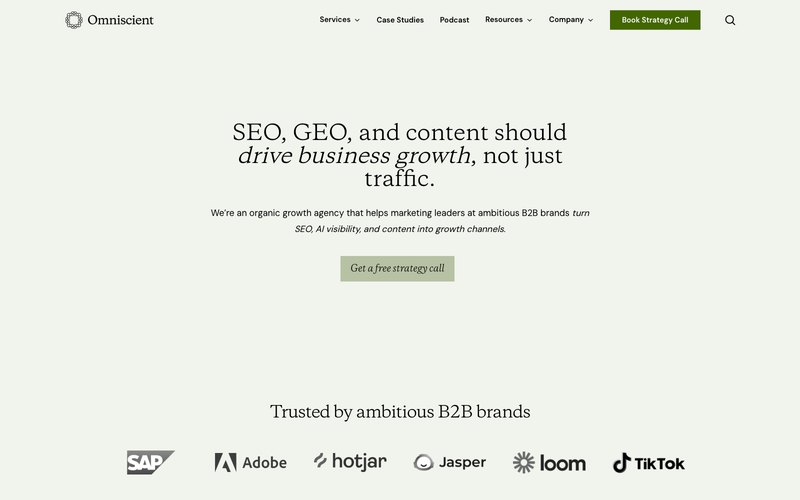
Omniscient Digital works with B2B software companies on organic growth, and its published case studies lead with pipeline and conversion figures rather than traffic. That emphasis is the right one for SaaS, where a large blog audience that never trials the product is an expensive hobby.
The team is known for content quality at scale, including work where clients were specifically worried about losing their own voice to an outsourced writing team.
Pros
- Case studies framed around pipeline and conversions
- Strong content production without losing brand voice
- AI visibility work alongside classic SEO
Cons
- Content led, so deep technical problems may need another partner
- No published pricing
3. Skale
Best for: SaaS companies measuring SEO in qualified leads
Core services: SaaS SEO strategy, content, technical SEO, outreach
Pricing: Custom pricing
Website: skale.so
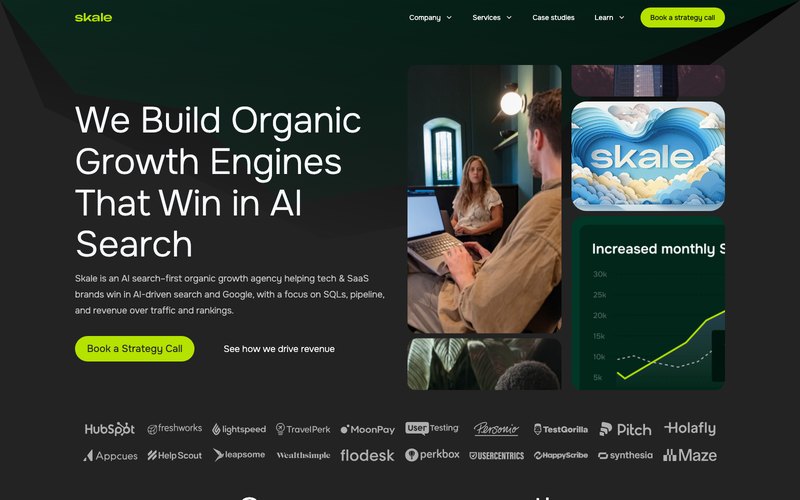
Skale works only with technology and SaaS brands and frames its outcome in qualified leads, pipeline and revenue rather than rankings. The agency is explicit that it targets efficient customer acquisition cost payback, which is the language a SaaS finance team actually uses.
Strategy, content, technical work and outreach are delivered together, so the link building is aimed at the pages the strategy says matter.
Pros
- Outcome defined in qualified leads rather than traffic
- Technology and SaaS only
- Strategy and execution in the same team
Cons
- Aimed at companies with existing revenue rather than pre product market fit
- No published pricing
4. Kalungi
Best for: B2B SaaS with no marketing team at all
Core services: Outsourced SaaS marketing department, demand generation, SEO, go to market
Pricing: Custom pricing
Website: kalungi.com
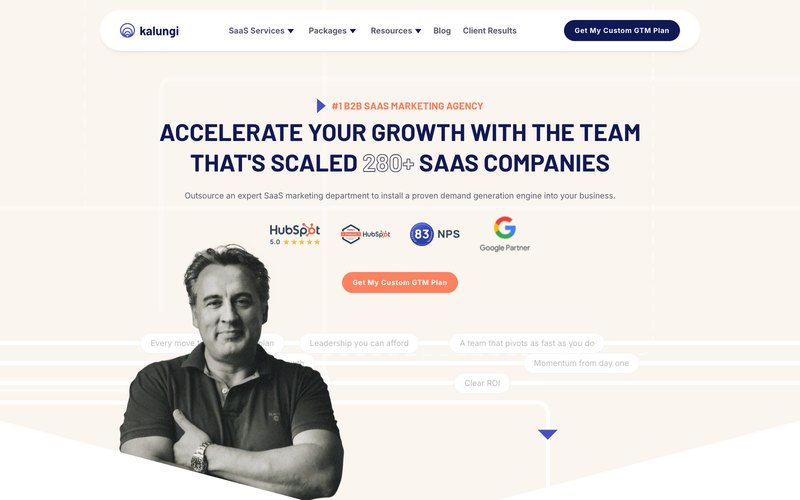
Kalungi sells an outsourced B2B SaaS marketing department rather than an SEO retainer, including fractional leadership. It states it has worked with more than 280 SaaS companies and publishes the T2D3 playbook that underpins its approach.
This is the right shape when the gap is not SEO specifically but the absence of any marketing function. SEO arrives as one part of a go to market engine rather than as a standalone channel.
Pros
- Fills the whole marketing function, not just search
- Fractional leadership included
- Documented methodology you can read before buying
Cons
- Overkill if you already have a marketing team and only need SEO
- No published pricing
5. Rank Shifters
Best for: SaaS companies whose comparison pages will not rank
Core services: SaaS link building, technical SEO, content, digital PR
Pricing: Custom, quoted within one working day
Website: rankshifters.com
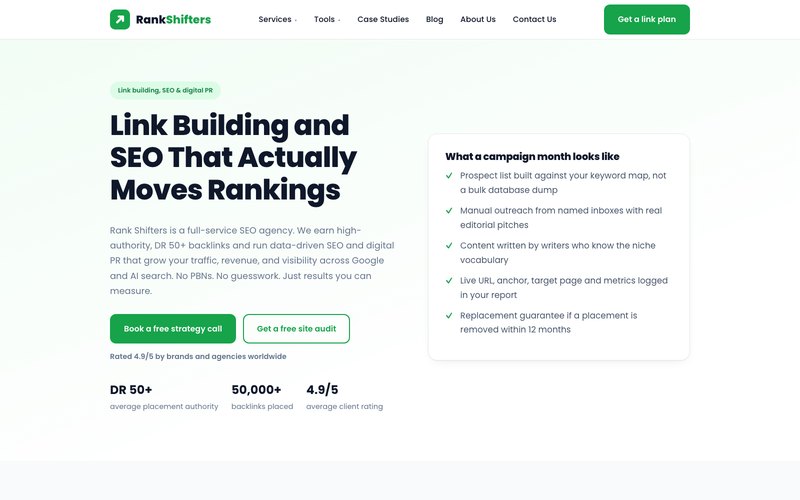
Comparison and alternatives pages are where SaaS deals are won in organic search, and they are also the hardest pages to earn links to. Rank Shifters runs SaaS link building as a named service and has documented campaigns where comparison URLs moved from the low twenties into the top five over roughly six months by concentrating referring domains on those specific pages.
Content is written by people who know the category vocabulary, which matters when the topic is a technical product. Every publisher is approved by the client before outreach, reporting shows the live URL, anchor and target page for each placement, and there is a twelve month replacement guarantee. There is no long term contract.
Pros
- Built around the bottom of funnel pages that actually convert
- Transparent reporting down to live URL and anchor
- Writers with genuine category knowledge
Cons
- Not an outsourced marketing department, so demand generation needs another partner
- Scoped per campaign rather than packaged
6. Foundation
Best for: B2B tech chasing visibility inside AI assistants
Core services: AI visibility, generative engine optimisation, content, distribution, SEO
Pricing: Custom pricing
Website: foundationinc.co
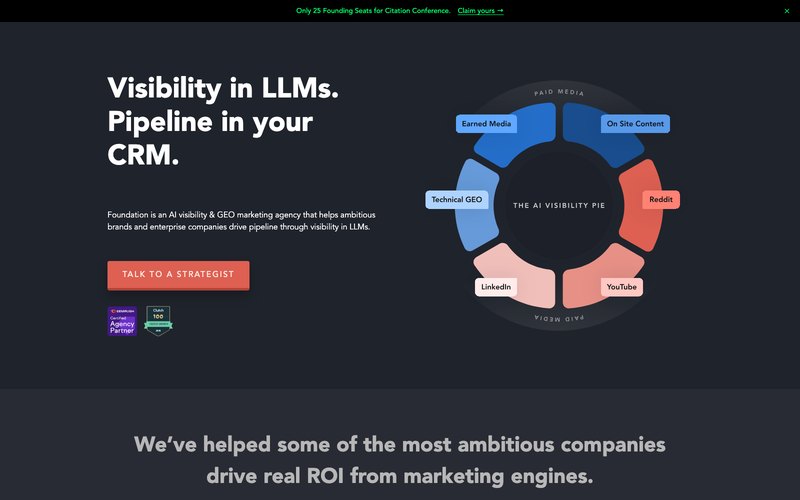
Foundation has repositioned around AI visibility for B2B technology companies, running citation research, content creation and distribution across the channels that large language models draw from, including Reddit, YouTube and niche publications.
If your concern is that buyers are asking an assistant for a shortlist and your product is not on it, this is an agency built around that exact problem.
Pros
- Specific, research led approach to AI citation visibility
- Distribution across the sources models actually cite
- Deep B2B technology focus
Cons
- Heavily weighted to AI visibility, less so to classic technical SEO
- No published pricing
7. Animalz
Best for: SaaS brands that need authority content at volume
Core services: Content strategy and production, SEO, answer engine optimisation, research reports
Pricing: Custom pricing
Website: animalz.co
Animalz is a content marketing agency for B2B SaaS, covering strategy, blog articles, research reports, white papers and thought leadership alongside SEO and answer engine work. The pitch is content good enough that it does not read as marketing.
For a company whose differentiation is expertise, this is the model that converts that expertise into a durable organic asset.
Pros
- Content quality is the core product, not a by-product
- Original research and reports as well as blog content
- Long standing reputation in B2B SaaS content
Cons
- Content first, so technical SEO and links are not the focus
- No published pricing
How to Spot a Real B2B Software Specialist
Four things separate an agency that genuinely works in a sector from one that lists it among thirty others. Each is checkable on the agency’s own site before you book a call.
- It names this type of client on its own site, rather than listing it as one of thirty verticals.
- SEO is the service being sold, not a bolt-on to a website build.
- Reporting and deliverables are described somewhere a prospect can read them before a sales call.
- Pricing is published, or it is clearly marked custom rather than left vague.
We did not score agencies on review counts or award badges. Both are easy to accumulate and neither tells you whether a team can move the pages that make you money.
Questions that expose a weak SaaS SEO pitch
Generic agency questions will not separate these firms. These will.
- Which bottom of funnel pages would you build first, and in what order?
- How do you plan to get links to a comparison page that promotes our product?
- How will you measure AI assistant visibility, and what will you do about it?
- Who writes the content, and can I read something they wrote in a technical category?
- How do you connect rankings to trials and pipeline in reporting?
- What is your view on writing alternatives pages that name competitors?
The second question is the one that matters most. Earning links to a page that exists to sell your product is genuinely hard, and an agency without a clear answer is planning to skip it.
Claims that should end the meeting
Most bad SEO engagements are visible in the sales call. These are the signals worth walking away from.
- A guaranteed number one ranking, which no agency can promise because no agency controls the algorithm.
- Refusal to name the publishers, pages or tactics behind link building.
- Reports built entirely on rankings and impressions, with no line connecting to leads or revenue.
- A twelve month contract signed before any audit has been done.
- Work handed to an anonymous team you never speak to after onboarding.
SaaS SEO costs and how they are structured
None of these agencies publishes a rate card, which is normal for this segment. The variables that drive the quote are predictable.
- How many bottom of funnel pages need building from scratch.
- Whether content is written in house or by the agency, and at what volume.
- How competitive the comparison and alternatives queries are in your category.
- Whether AI search visibility is in scope, which adds research and distribution work.
- Whether link building is included, which is usually the largest single line.
If you are weighing which pages deserve budget first, our guide to brand mentions and unlinked citations covers a cheaper starting point that most software companies have already earned and never claimed.
Frequently Asked Questions
What makes SaaS SEO different from regular SEO?
The page types and the measurement. SaaS campaigns live or die on comparison, alternatives, integration and use case pages rather than on informational blog content, and success is measured in trials and pipeline rather than sessions. The technical work also has to account for documentation and app subdomains, which most sites do not have.
How long does SaaS SEO take to produce pipeline?
Bottom of funnel pages in a low competition category can produce trials within three to four months because the search volume is small but the intent is immediate. Competitive categories where review sites own every comparison query take considerably longer, because you have to earn enough authority to displace them.
Do we still need SEO if buyers use AI assistants?
Yes, and more of it. Assistants draw on indexed content, cited sources and third party mentions, which means the work that makes you visible in an assistant overlaps heavily with the work that makes you rank. Several agencies here, including SimpleTiger and Foundation, now treat the two as one programme.
Should we hire a SaaS specialist or a general agency?
A specialist, in almost every case. Google’s guide to its ranking systems describes systems that apply everywhere, but the page types, the buyer journey and the vocabulary are specific enough that a general agency spends the first three months learning what a specialist already knows. That learning time is billed to you.
Which one fits your stage
No marketing team at all, Kalungi. Content is the gap, Animalz or Omniscient Digital. Worried about AI assistant visibility, Foundation or SimpleTiger. If your comparison pages are well written and still sitting on page two, the missing piece is authority, which is what our SaaS link building service is scoped to fix. Ask all three finalists how they plan to earn links to a page that sells your product, and compare the answers.
Related Articles

Ayush Shah
Ayush Shah is the founder of RankShifters.com, with a background in SEO, link building, content writing, and digital marketing. He works with businesses, startups, and agencies, and shares what he's learned about search and online growth.
Keep reading
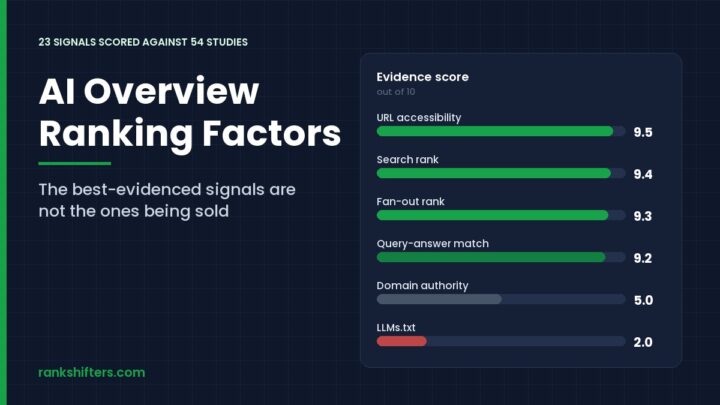
AI Overview Ranking Factors: 23 Signals, Ranked
AI Overview ranking factors are not a separate ruleset bolted on top of search. Google builds the answer box from pages already in its index, then…
Read the guide →
Local SEO vs National SEO: Which One Do You Need?
How local SEO and national SEO differ in ranking factors, content, link building, cost and timeline, and how to tell which one your business actually needs.
Read the guide →
DIY SEO vs Hiring an SEO Company: How to Decide
A practical comparison of doing SEO yourself against hiring an agency, covering real costs, the time it takes, where DIY hits a ceiling, and five agencies…
Read the guide →