7 Best SEO Companies for Ecommerce Businesses
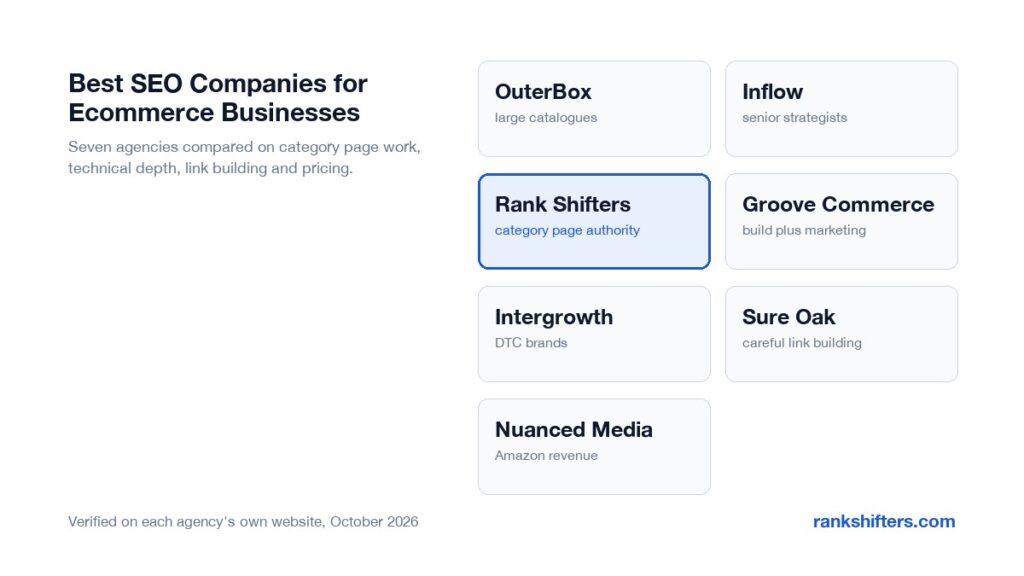
Seven agencies that work on ecommerce SEO, compared on category and product page work, technical crawl issues, link building and what each publishes about price.
-
Ayush Shah
- Updated October 11, 2026
- 10 min read
What this guide covers
Ecommerce SEO fails in places that never trouble a brochure site. Faceted navigation generates thousands of near duplicate URLs. Out of stock products disappear and take their rankings with them. Category pages, which are the highest value templates on the site, are often the thinnest pages on it. None of this is fixed by publishing more blog posts.
So the question is not which agency is good at SEO. It is which agency has dealt with a crawl budget problem on a hundred thousand URL store, and which one knows that a category page needs to rank and convert at the same time. Each of the seven below names ecommerce or retail as a practice rather than a passing mention.
The parts of ecommerce SEO that actually move revenue
An ecommerce audit that only covers titles and meta descriptions has missed the job. These are the areas worth paying for.
- Category page strategy, because category pages carry the commercial keywords and most stores treat them as navigation.
- Crawl control across filters, sorts and parameters. Google’s guidance on faceted navigation is the baseline reference here.
- Product markup that is complete and accurate, following product structured data documented by Google.
- A policy for discontinued and out of stock products that does not throw away earned rankings.
- Link building aimed at category and collection pages, not only at the homepage and the blog.
- Internal linking that pushes authority from content down into the pages that take the money.
Seven ecommerce SEO agencies side by side
Figures are listed only where the agency publishes them. Everything else reads custom, because guessing at a retainer helps nobody.
| Agency | Best for | Core services | Pricing |
|---|---|---|---|
| OuterBox | Large catalogues and complex storefronts | Ecommerce SEO, paid search, CRO, ecommerce web design | Custom pricing |
| Inflow | Mid market stores that want senior strategists | Ecommerce SEO, technical SEO, PPC, CRO | Custom pricing |
| Rank Shifters | Stores that need authority behind category pages | Ecommerce link building, technical SEO, content, digital PR | Custom, quoted within one working day |
| Groove Commerce | Shopify and BigCommerce stores needing build plus marketing | Ecommerce SEO, PPC, design, development, email and SMS | Custom pricing |
| Intergrowth | Direct to consumer brands with long horizons | SEO, answer engine optimisation, content marketing, Meta Ads | Custom pricing |
| Sure Oak | Brands that need authority building done carefully | SEO, generative engine optimisation, link building, content marketing | Custom pricing |
| Nuanced Media | Sellers whose revenue sits on Amazon | Amazon market intelligence, advertising, listing optimisation, creative | Custom pricing |
The seven agencies, ranked by who they suit
1. OuterBox
Best for: Large catalogues and complex storefronts
Core services: Ecommerce SEO, paid search, CRO, ecommerce web design
Pricing: Custom pricing
Website: outerboxdesign.com
OuterBox was founded in 2004 and states that it now runs with more than 300 digital marketing staff, with ecommerce design and search as the core of the business. For a store with a large catalogue and a platform migration on the horizon, that combination of design, development and SEO in one place is the differentiator.
The agency works across the full size range from small retailers to Fortune 500 brands, which means the process is built to handle catalogue complexity rather than assuming a few hundred SKUs.
Pros
- Ecommerce design, development and SEO under one roof
- Built for large catalogues rather than small storefronts
- Long operating history in the retail search space
Cons
- Large agency, so senior attention is not guaranteed day to day
- No published pricing
2. Inflow
Best for: Mid market stores that want senior strategists
Core services: Ecommerce SEO, technical SEO, PPC, CRO
Pricing: Custom pricing
Website: goinflow.com
Inflow was founded in 2007 and sells direct access to its most senior strategists as a deliberate part of the model, alongside ecommerce and lead generation specialisms. For a store where the problem is strategy rather than execution volume, that is a meaningful distinction.
The agency pairs SEO with conversion rate optimisation, which matters for ecommerce in a way it does not for lead generation. Traffic to a category page that converts at half the site average is an expensive way to lose money.
Pros
- Senior strategists on the account rather than junior execution
- SEO and conversion work treated as one problem
- Long standing ecommerce focus
Cons
- Mid market positioning, so very small stores may find it a stretch
- No published pricing
3. Rank Shifters
Best for: Stores that need authority behind category pages
Core services: Ecommerce link building, technical SEO, content, digital PR
Pricing: Custom, quoted within one working day
Website: rankshifters.com
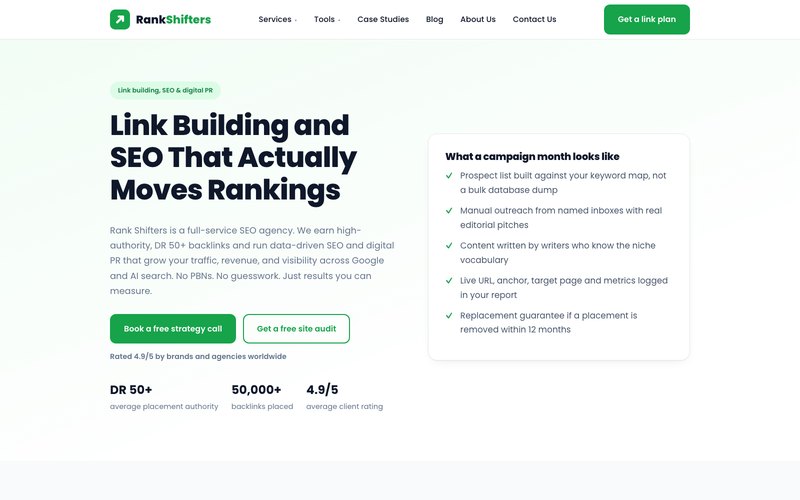
Most ecommerce stores lose the commercial query not because the page is badly optimised but because nothing links to it. Rank Shifters runs ecommerce link building as a named service and scopes campaigns around the revenue pages in your keyword map rather than around the homepage.
The process is deliberately auditable. You approve every publisher before outreach begins, each report lists the live URL, anchor text and target page, and placements carry a twelve month replacement guarantee. Pricing arrives within one working day, with no discovery call required first and no long term contract.
Pros
- Campaigns scoped around category and collection pages, not the homepage
- Every publisher approved by you before outreach
- Twelve month replacement cover on placements
Cons
- Not a platform development shop, so migrations need a separate partner
- No off the shelf packages
4. Groove Commerce
Best for: Shopify and BigCommerce stores needing build plus marketing
Core services: Ecommerce SEO, PPC, design, development, email and SMS
Pricing: Custom pricing
Website: groovecommerce.com
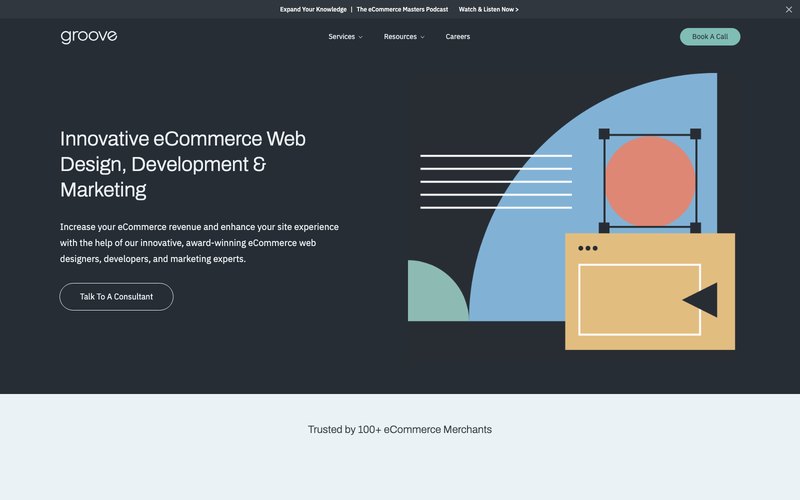
Groove Commerce has operated since 2007 across six practices covering design, development, B2B ecommerce, SEO, paid media and lifecycle messaging. The pitch is explicitly against running siloed agencies, which is a real cost for mid market merchants juggling a developer, an SEO and an email vendor.
If your SEO problem is partly a platform problem, having certified developers in the same team shortens the loop between finding an issue and shipping the fix.
Pros
- Platform certified developers alongside the SEO team
- Covers B2B ecommerce, which many agencies skip
- Lifecycle marketing in the same engagement
Cons
- Broad service mix means SEO is one practice among six
- No published pricing
5. Intergrowth
Best for: Direct to consumer brands with long horizons
Core services: SEO, answer engine optimisation, content marketing, Meta Ads
Pricing: Custom pricing
Website: intergrowth.com
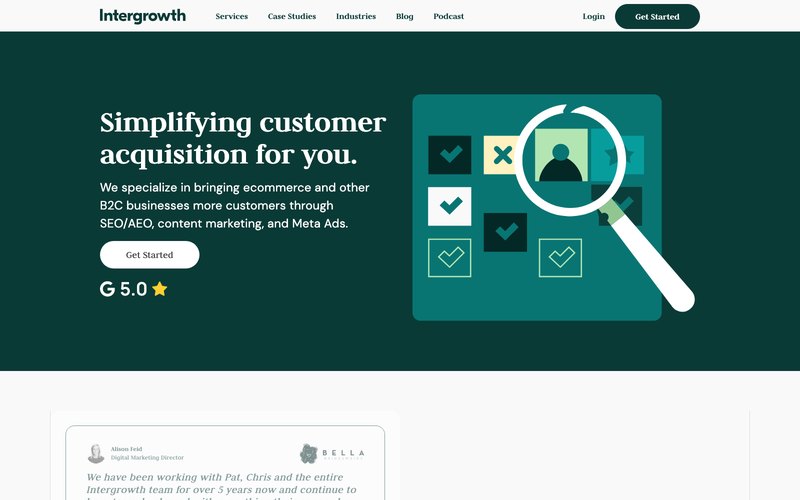
Intergrowth is a Denver based agency focused on ecommerce and other consumer businesses, combining organic search with content marketing and paid social. Several of the testimonials on its own site describe multi year relationships, which is the pattern you want to see in a channel that compounds.
The agency has added answer engine optimisation to its named services, which reflects where consumer product research is increasingly happening.
Pros
- Consumer and ecommerce focus rather than generalist
- Organic and paid social treated as one acquisition system
- Visible pattern of long client relationships
Cons
- Smaller team than the enterprise agencies here
- No published pricing
6. Sure Oak
Best for: Brands that need authority building done carefully
Core services: SEO, generative engine optimisation, link building, content marketing
Pricing: Custom pricing
Website: sureoak.com
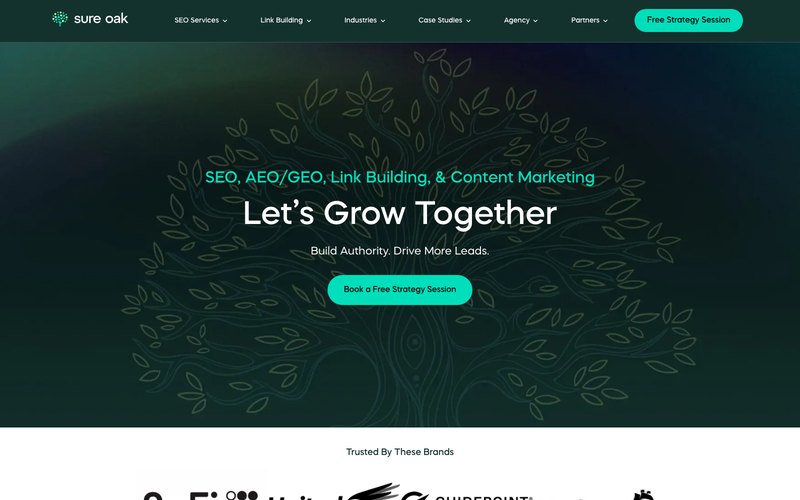
Sure Oak pairs every client with a strategist carrying more than a decade of experience and is openly critical of agencies that cut costs through heavy automation and offshoring. For an ecommerce brand that has been burned by cheap link packages, that stance is the selling point.
Link building and content sit at the centre of the offer, with generative engine optimisation added as AI surfaces take a larger share of product research.
Pros
- Senior strategist assigned to every engagement
- Explicit position against cheap automated link building
- Content and authority work in the same programme
Cons
- Not an ecommerce only agency
- No published pricing
7. Nuanced Media
Best for: Sellers whose revenue sits on Amazon
Core services: Amazon market intelligence, advertising, listing optimisation, creative
Pricing: Custom pricing
Website: nuancedmedia.com
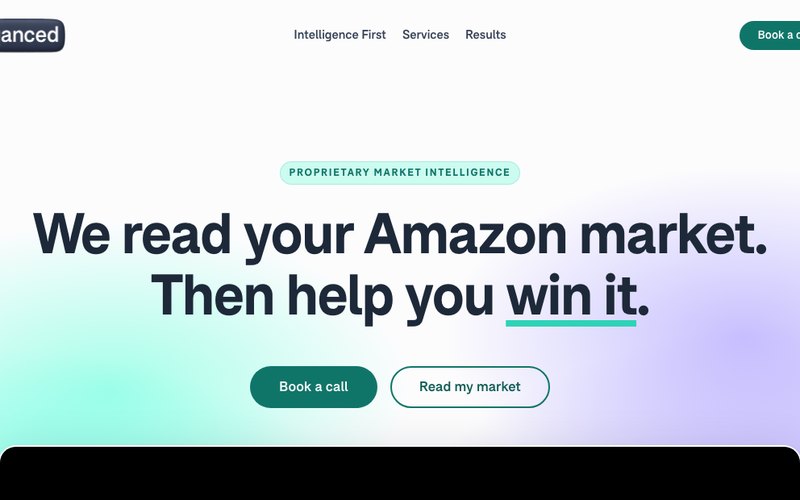
Nuanced Media is included with a caveat: this is marketplace work rather than classic search engine optimisation. If most of your revenue comes through Amazon, your ranking problem lives inside Amazon’s search, and a Google focused agency will not help with it.
The agency runs proprietary category intelligence first and then executes against it across advertising, creative and operations. Treat it as a complement to a web SEO partner rather than a replacement.
Pros
- Genuine marketplace specialism rather than a bolt-on Amazon service
- Research led, with a category view before spend starts
- Useful when Amazon is the main revenue channel
Cons
- Not a substitute for website SEO
- Irrelevant if you do not sell on Amazon
What Marks Out a Genuine Ecommerce Specialist
Four things separate an agency that genuinely works in a sector from one that lists it among thirty others. Each is checkable on the agency’s own site before you book a call.
- It names this type of client on its own site, rather than listing it as one of thirty verticals.
- SEO is the service being sold, not a bolt-on to a website build.
- Reporting and deliverables are described somewhere a prospect can read them before a sales call.
- Pricing is published, or it is clearly marked custom rather than left vague.
We did not score agencies on review counts or award badges. Both are easy to accumulate and neither tells you whether a team can move the pages that make you money.
What to ask an ecommerce SEO agency on the first call
Ecommerce has specific failure modes, so the discovery questions should be specific too.
- How will you handle faceted navigation and parameter URLs on my store?
- What is your policy for products that go out of stock or get discontinued?
- Which category pages would you prioritise first, and why those?
- How do you build links to category pages rather than to the homepage?
- How will you measure success: sessions, revenue, or assisted revenue?
- Who writes the category copy, and how do you stop it reading like filler?
An agency that cannot answer the first two questions in detail has not worked on a large store. Those two issues account for a large share of wasted crawl budget in retail search.
Warning signs worth walking away from
Most bad SEO engagements are visible in the sales call. These are the signals worth walking away from.
- A guaranteed number one ranking, which no agency can promise because no agency controls the algorithm.
- Refusal to name the publishers, pages or tactics behind link building.
- Reports built entirely on rankings and impressions, with no line connecting to leads or revenue.
- A twelve month contract signed before any audit has been done.
- Work handed to an anonymous team you never speak to after onboarding.
Budgeting for ecommerce search work
Ecommerce retainers tend to run higher than local or small business SEO, for reasons that are structural rather than opportunistic.
- Catalogue size drives the work. Ten thousand SKUs is a different technical job from fifty.
- Category pages need real copy, and real copy at scale costs money.
- Commercial link building is harder and slower than informational link building.
- Migrations, replatforming and international expansion are project costs on top of the retainer.
If you are weighing organic against paid, our breakdown of SEO versus PPC covers how the two channels behave differently over a twelve month window.
Frequently Asked Questions
How long before ecommerce SEO affects revenue?
Technical fixes on a store with real problems can show up in crawl and indexation data within weeks. Revenue movement from improved category rankings usually takes four to eight months, and competitive head terms take longer. Anyone promising a revenue lift inside a quarter is describing paid search, not organic.
Should ecommerce SEO focus on category or product pages?
Category pages first in most cases. They target the broader commercial keywords, they stay live when individual products are discontinued, and they are easier to build links to. Product pages matter for branded and model number searches, which convert well but have smaller volume.
Do I need a different agency for Amazon and for Google?
Usually yes. Amazon ranking depends on sales velocity, listing quality and advertising inside a closed marketplace, while Google depends on crawlable pages, content and links. The skills overlap less than people expect, which is why marketplace specialists exist.
Is link building still necessary for ecommerce?
Yes, and it is usually the gap. Google’s guide to its ranking systems describes multiple systems working together, and competitive commercial queries are rarely won on page quality alone. The practical issue is that category pages are harder to earn links to than blog content, which is why most stores quietly skip it.
Choosing between them
If your catalogue is large and messy, OuterBox or Groove Commerce bring the development capacity to fix it. If strategy is the gap, Inflow and Intergrowth are the stronger fit. If your category pages are well built and still not ranking, the missing ingredient is almost always authority, which is where our ecommerce link building work is aimed. Shortlist three and ask every one of them the faceted navigation question. The answers will not be similar.
Related Articles

Ayush Shah
Ayush Shah is the founder of RankShifters.com, with a background in SEO, link building, content writing, and digital marketing. He works with businesses, startups, and agencies, and shares what he's learned about search and online growth.
Keep reading
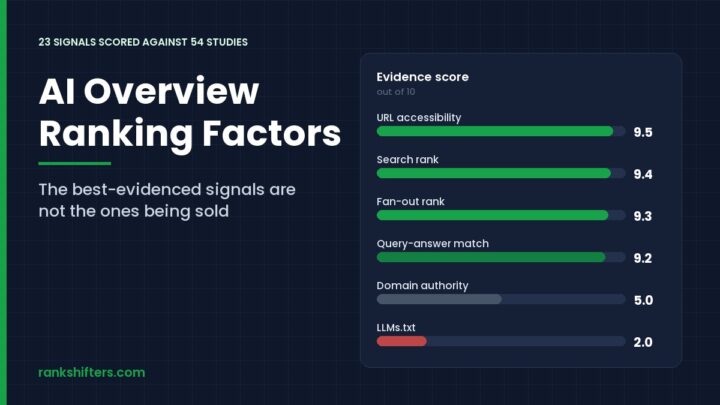
AI Overview Ranking Factors: 23 Signals, Ranked
AI Overview ranking factors are not a separate ruleset bolted on top of search. Google builds the answer box from pages already in its index, then…
Read the guide →
Local SEO vs National SEO: Which One Do You Need?
How local SEO and national SEO differ in ranking factors, content, link building, cost and timeline, and how to tell which one your business actually needs.
Read the guide →
DIY SEO vs Hiring an SEO Company: How to Decide
A practical comparison of doing SEO yourself against hiring an agency, covering real costs, the time it takes, where DIY hits a ceiling, and five agencies…
Read the guide →